


Orthodontic terms, defined in plain words
Orthodontics has its own vocabulary, and this glossary defines it one word at a time: a plain sentence for each term, and a page that names its source.
The glossary defines orthodontic terms in one plain sentence each and links every term to a page of its own. Where the Glossary of Orthodontic Terms of the American Association of Orthodontists (AAO) has an entry for a word, the definition follows the AAO’s wording; where it has none, the term’s page names the publisher it follows instead.
Definitions that start from the American Association of Orthodontists
The definitions in this glossary start from the Glossary of Orthodontic Terms published by the American Association of Orthodontists (AAO). Where the AAO defines a word there, the one-sentence definition follows the AAO’s wording, and the term’s own page names the AAO in the sentence that uses its words.
Some words an orthodontist uses have no entry in the AAO’s glossary. For those, the term’s page follows another source that defines the word and names it in the same sentence: another of the AAO’s own pages, the American Academy of Pediatric Dentistry for some words about children’s teeth and appliances, Align Technology for the words that belong to its aligners, or a published review.
When a word you met on the practice’s treatment pages or heard at a consultation is in the glossary, its page links the source under Sources, so the definition can be checked where it was published.
From each term to the page that covers its subject
Each term in the glossary’s list is followed by its one-sentence definition and opens a page of its own, which gives the definition with its source and points to the page that covers the subject in full. A definition stays a definition: what a treatment involves is set out on the page the term links, not repeated in the glossary.
The words for keeping teeth in place after treatment link the page on retainers after braces or aligners, and the words about a growing child’s teeth and appliances link the page on treatment for children and teens. Most words for bite problems link an answer page in the questions hub, where bite problems are answered one question to a page.
What a definition leaves to the orthodontist
A definition says what a word means, not whether it describes your bite. Whether you have an overjet, a crossbite or crowding, and what would correct it, is for the orthodontist to judge after examining your teeth, and a consultation is the place to ask.
Questions about the practice rather than its vocabulary are answered on the home page: the hours, insurance and referrals are in its questions section, and the Find us page shows where each of the three offices is.
Bite problems
Most of these have a page of their own among the questions.
- Malocclusion
- Malocclusion is the term orthodontics uses for teeth that do not fit together properly, as defined in the glossary of the American Association of Orthodontists, which gives the word as Latin for bad bite.
- Overbite
- Overbite, according to the glossary of the American Association of Orthodontists, is the upper front teeth excessively overlapping the bottom front teeth when the back teeth are closed, a bite the glossary also calls a closed bite or deep bite.
- Overjet
- Overjet is a bite in which the upper front teeth protrude in front of the bottom front teeth when the back teeth are closed, in the glossary of the American Association of Orthodontists, which says it is sometimes called buck teeth.
- Deep bite
- Deep bite, filed in the glossary of the American Association of Orthodontists under Closed Bite/Deep Bite and also known as deep overbite, occurs when the upper front teeth overlap the bottom front teeth an excessive amount.
- Underbite
- Underbite, also known as a Class III malocclusion in the glossary of the American Association of Orthodontists, describes a bite in which the lower front teeth or jaw sit ahead of the upper front teeth or jaw.
- Crossbite
- Crossbite is defined in the glossary of the American Association of Orthodontists as upper back teeth that erupt and contact inside or outside the lower back teeth, or lower front teeth that erupt in front of the upper front teeth.
- Open bite
- Open bite is a malocclusion in which teeth do not make contact, as the glossary of the American Association of Orthodontists defines it, whether at the front with the back teeth closed or at the back with the front teeth closed.
- Crowding
- Crowding, in an article by the American Association of Orthodontists on common bite problems, is a condition with insufficient space for the teeth, so that they overlap, twist, or are pushed to the front or back.
- Spacing (gaps)
- Spacing is the orthodontic term for gaps or spaces between teeth, which the American Association of Orthodontists says may appear as a small space between the front teeth or as multiple spaces throughout the smile.
- Impacted tooth
- An impacted tooth is a tooth that does not erupt into the mouth, or erupts only partly, as the American Association of Orthodontists’ Glossary of Orthodontic Terms defines it.
The parts of braces
These words come up on the braces page.
- Bracket
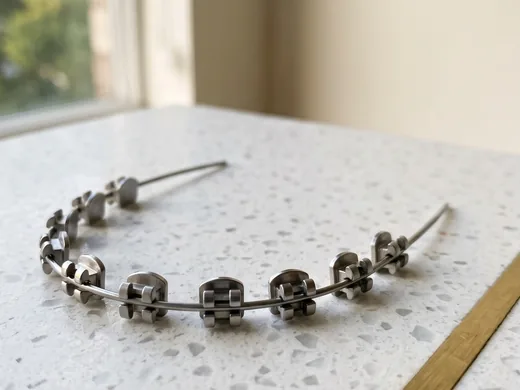
- Bracket is the name for the small metal, ceramic or plastic attachment that the American Association of Orthodontists says is bonded to each tooth with a tooth-colored adhesive and has a slot that the orthodontic wire fits into.
- Archwire
- Archwire is the metal wire attached to braces and used to move the teeth, as the American Association of Orthodontists defines it, fitting into the slots in the brackets on each tooth.
- Orthodontic elastics (rubber bands)
- Orthodontic elastics are small rubber bands that the American Association of Orthodontists says are worn during certain stages of treatment to provide individual tooth movement or jaw alignment.
The aligner words
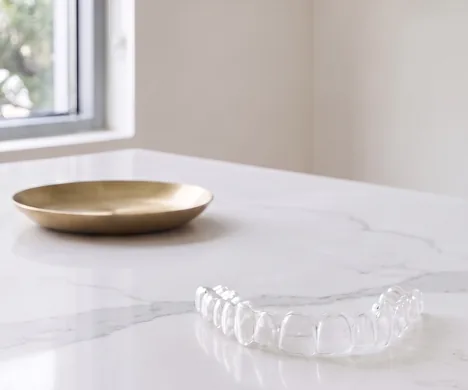
These words come up on the clear aligners page.
- Aligner attachment
- Aligner attachment refers to the tooth-colored bumps that the American Association of Orthodontists says are placed on teeth during clear aligner treatment, help move the teeth while aligners are worn, and are removed once treatment is complete.
- Interproximal reduction (IPR)
- Interproximal reduction (IPR) is the removal of some enamel, the outer tooth surface, from between the teeth, and the American Association of Orthodontists says the goal is to acquire more space for the teeth.
- Refinement (aligners)
- Refinement, in clear aligner treatment, means additional aligner sets, which Align Technology describes as sets that fine-tune the final result.
Children’s teeth and early treatment
These words come up on the children and teens page.
- Mixed dentition
- Mixed dentition is the stage of dental development in children when baby teeth and permanent teeth are in the mouth together, which the American Association of Orthodontists’ glossary places at approximately ages 6 to 12.
- Palatal expander
- A palatal expander is an orthodontic appliance, fixed or removable, that widens the upper jaw, as the American Association of Orthodontists’ Glossary of Orthodontic Terms defines it.
- Habit appliance
- A habit appliance is an orthodontic appliance aimed at an oral habit; the American Association of Orthodontists says tongue positioning when swallowing and thumb or finger sucking are sometimes treated with habit appliances.
- Space maintainer
- A space maintainer is a fixed appliance that holds space for a permanent tooth still to come in after a baby tooth is lost too early, through an accident or decay, as the American Association of Orthodontists defines it.
Retention, relapse and the risks of treatment
These words come up on the retainers page and, for root resorption, on the adults page.
- Retention
- Retention is the stage after active orthodontic treatment when retainers are worn, and the American Association of Orthodontists describes a retainer as fitted to hold the teeth in their finished positions and to minimize unwanted tooth movement.
- Relapse
- Relapse is the shifting of straightened teeth after orthodontic treatment, which the American Association of Orthodontists says can happen after braces are removed because teeth naturally tend to move over time.
- Fixed retainer
- A fixed retainer is a custom-fitted slender wire cemented or bonded to the inner side of the upper or lower teeth, as the American Association of Orthodontists describes it, also called a bonded or permanent retainer.
- Root resorption
- Root resorption is a permanent loss of tooth structure from the root apex, the tip of the root, as a 2017 study by Gay and colleagues in Progress in Orthodontics describes it.
Sources
- American Association of Orthodontists, Glossary of Orthodontic Terms
Bring a term you want explained to a consultation
Consultations are always free of charge. You do not need a referral. Ask for a consultation from this page and bring the word with you, written down the way you met it.
Domain, Downtown and Westlake: Monday to Thursday, 8:15 a.m. to 5:00 p.m.Updated .