

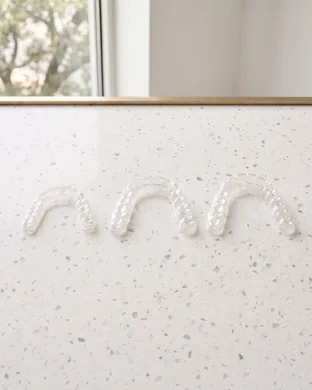
Hybrid treatment: The Braces Phase, then The Invisalign® Phase
We may adjust your braces, provide new aligner sets, or transition between methods as your treatment progresses.
Hybrid treatment combines braces with clear aligners; in the braces-first form, brackets and wires go on before the aligners. Braces go first for movements that reviews call less predictable with aligners, among them rotations, extrusion, root control and closing extraction spaces; the American Association of Orthodontists says braces may offer more precision for significant rotations. The order rests on overviews and case reports, not trials; an orthodontist decides who needs a braces phase.
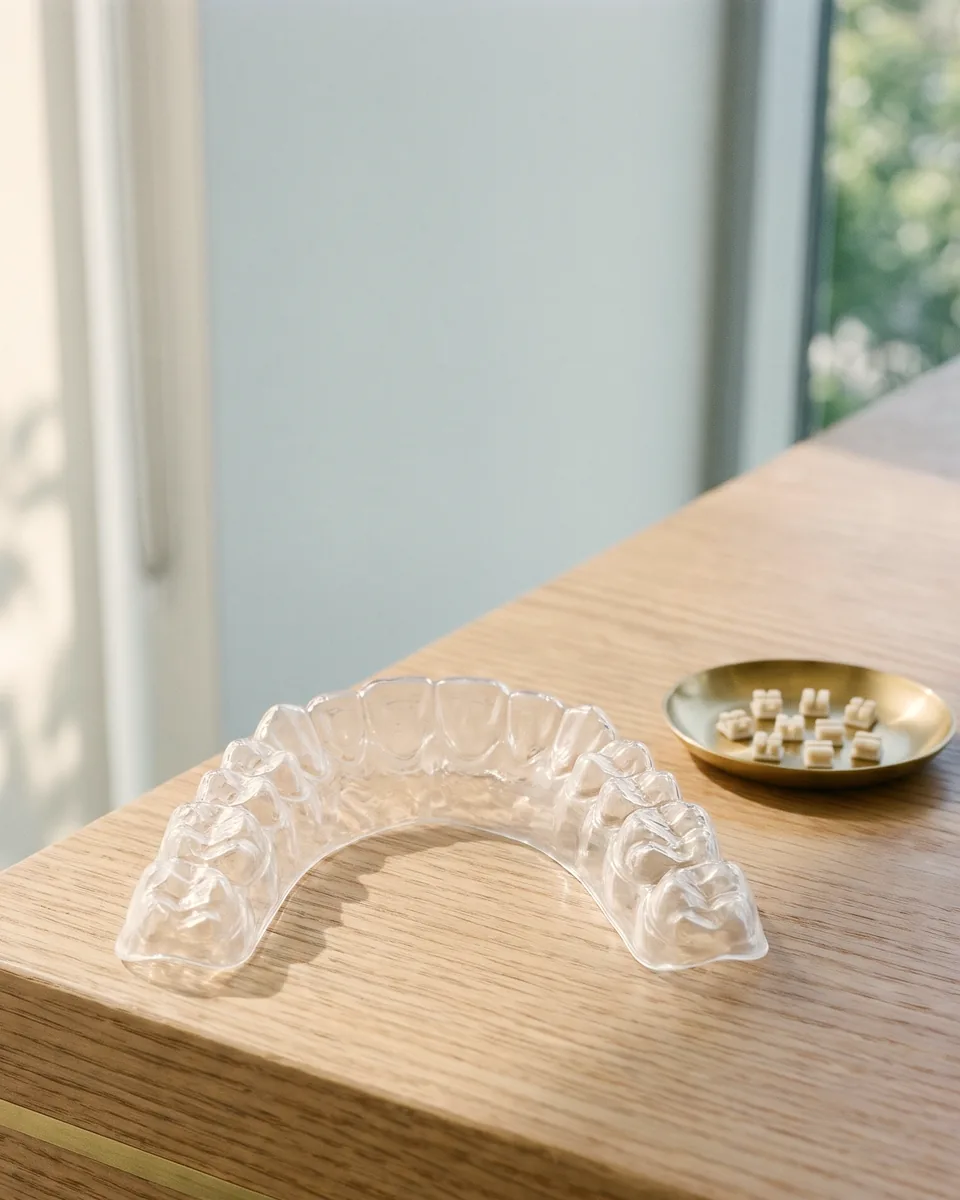
Why Hybrid treatment comes in two phases
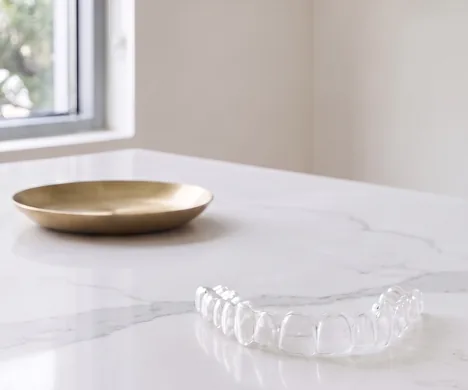
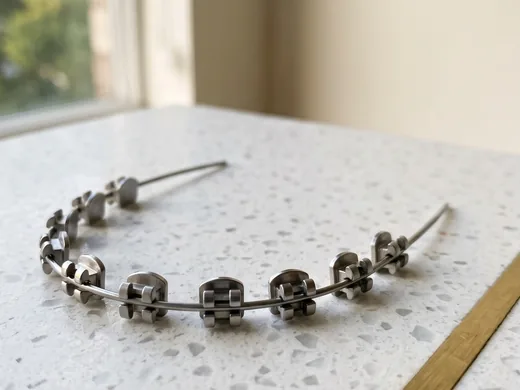
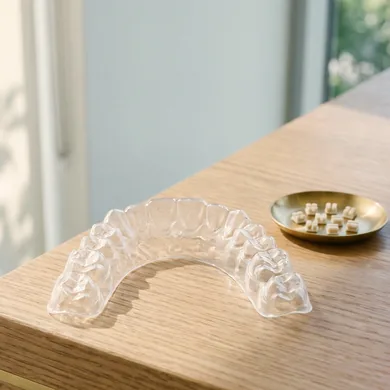
Hybrid treatment at Kunik Orthodontics runs in two phases, and the practice names them The Braces Phase and The Invisalign Phase. In the first phase the teeth are moved with braces, which the American Association of Orthodontists (AAO) describes as “a fixed orthodontic appliance, usually consisting of brackets, bands and wires.” In the second, the work moves to Invisalign clear aligners, a series of thin, removable trays custom-formed to fit the mouth.
A sequence exists because the two appliances are not equally predictable for every tooth movement. A 2023 overview in the Journal of Clinical Orthodontics describes hybrid aligner treatment as using “the advantages of removable clear aligners while still accounting for their limitations in producing certain tooth movements,” and the AAO says an orthodontist’s recommendation “may include aligners, braces, or a combination of approaches.”
That is why, in the order the journals describe, the braces come first: brackets and wires take the movements aligners handle less predictably, and aligners follow. Whether your teeth need a braces phase at all, and for which movements, is a question for Dr. Kunik at the consultation.
Why some tooth movements start in brackets and wires
Some tooth movements start in brackets and wires because research finds them less predictable with aligners. The American Association of Orthodontists (AAO) says: “Clear aligners may not work as predictably for severe malocclusions, significant tooth rotations, and large gaps. Traditional braces may offer more precision in these cases.” Reviews of the research name these movements in particular:
- Rotations. A 2021 systematic review and meta-analysis in the Journal of Orthodontics concluded: “Allowing for all identified caveats, prediction of rotational tooth movements with aligner treatment does not appear accurate, especially for canines.” A 2015 systematic review in The Angle Orthodontist found aligners “not effective in controlling rotation of rounded teeth in particular.”
- Extrusion. The same 2015 review found aligners not effective in controlling anterior extrusion, and a 2025 clinical article in the Dental Press Journal of Orthodontics argues that extrusion is particularly challenging for aligners “due to their reliance on the elasticity of the plastic and patient compliance, rather than precise load system found in fixed appliances.” That is one author’s reasoning, not a measurement.
- Root control. A 2026 systematic review and meta-analysis of treatment with premolar extractions found that, “compared to fixed appliances, aligners exhibited inferior root control and occlusal contact scores,” and the 2025 article counts root torque among the movements it says aligners struggle to control reliably.
- Closing extraction spaces. A 2026 scoping review in Frontiers in Dental Medicine says the evidence suggests aligner therapy is “less predictable for certain types of tooth movement,” naming the closure of extraction spaces among them, along with rotations.
Brackets and wires act on a tooth in a different way from a tray: in the AAO’s words, archwires “fit into the slots in the brackets and are responsible for actually moving your teeth.”
Less predictable does not mean impossible: a 2023 randomized trial in young adults with severe crowding treated with first premolar extractions found no significant difference between clear aligners and fixed appliances in total ABO Objective Grading System scores, though occlusal contacts were significantly better with fixed appliances. So the case for a braces phase is made tooth by tooth; the braces page explains how braces move teeth.
What clear aligners do in The Invisalign Phase
The Invisalign Phase moves the rest of a Hybrid plan into removable trays. The 2025 clinical article in the Dental Press Journal of Orthodontics that describes this order gives the last stretch of treatment to aligners for “the aesthetic and hygienic advantages of aligners in the finishing phase,” and the American Association of Orthodontists (AAO) puts the difference simply: “Clear aligners are removable trays. Ceramic braces are fixed appliances.”
For daily life, removability is what changes. The AAO says “Aligners can also make brushing and flossing feel more familiar because patients remove them for oral hygiene,” and the practice’s own line on its aligners makes the same point. Your Invisalign aligners are fully removable for meals, giving you complete flexibility for eating.
Aligners are not only a finishing tool: a 2025 systematic review and meta-analysis in the European Journal of Orthodontics concluded that both clear aligners and fixed appliances achieve orthodontic treatment goals, with case complexity and patient compliance guiding the choice of appliance. The clear aligners page goes into the mechanics of Invisalign clear aligners.
Daily life in each phase: care with brackets, then wear with trays
Daily life changes between the two phases of a Hybrid plan: The Braces Phase asks for care around fixed brackets, and The Invisalign Phase asks for steady wear of removable trays. For the braces phase, the American Association of Orthodontists (AAO) says “Those with braces must steer clear of foods that are hard, sticky, crunchy and chewy to avoid breaking a bracket or popping a wire out of the bracket.”
The AAO also says to “let your orthodontist know immediately about any urgent orthodontic problems that occur, such as broken brackets or loose wires.” If you call our regular phone number after hours, you will hear the phone number of the person on call.
In The Invisalign Phase the routine is about wear. Align Technology, which makes Invisalign aligners, says: “Invisalign treatment requires consistent and responsible wear. Because Invisalign aligners are removable, you must be diligent about wearing your aligners for the recommended 20 to 22 hours daily.”
Those are general instructions from Align and the AAO; your own wear hours and tray changes are the orthodontist’s prescription for your plan.
What the research on combined treatment shows, and where it stops
Research on a braces phase followed by aligners is thinner than research on either appliance alone, and it starts with a problem of definition. A 2023 overview in the Journal of Clinical Orthodontics defines hybrid aligner treatment as “the combination of clear aligners with other devices, including fixed appliances,” and adds: “Not all uses of fixed appliances constitute hybrid aligner treatment, which makes it challenging to define this technique.” A 2026 scoping review speaks of fixed appliances used at the beginning or at the end of aligner therapy. In the journals, hybrid covers several combinations; the practice uses Hybrid for one of them, braces and then aligners.
The published support for putting braces first is clinical experience and case descriptions. The 2023 overview is a column giving the authors’ opinion, the 2025 Dental Press article is one author’s account illustrated with treated cases and no comparison group, and among the orthodontic PubMed records whose titles name a hybrid aligner approach, searched in November 2026, one is a retrospective cohort and the rest are case reports and technique, case or overview articles. That search found no randomized or controlled trial of a hybrid protocol, and the 2026 scoping review lists hybrid use among the areas that still need study, alongside prospective randomized trials.
The one comparative study of a named hybrid approach in that search tested something else: a 2026 retrospective cohort that paired a different aligner system with a partial fixed appliance to correct rotated canines and premolars, so its findings say nothing direct about braces followed by Invisalign aligners.
None of this research measures whether the sequence changes how long treatment takes, so this page makes no claim about time. What the evidence does support is narrower and still useful: certain movements are less predictable with aligners, and that is the reason the journals give for a braces phase.
Who might be offered a Hybrid plan
The sources describe the need for a braces phase before aligners in terms of tooth movements and clinical situations, not kinds of patients. A 2023 overview in the Journal of Clinical Orthodontics says placing fixed appliances before the aligners is usually employed “following premolar or lower-incisor extractions or surgical exposure of impacted teeth,” and a 2026 scoping review says combined approaches “may be appropriate for managing impacted teeth, rotations, closure of extraction spaces, or severe malocclusions.” Those are the journals’ examples, not a description of the practice’s patients.
Whether your teeth call for a braces phase, which teeth, and which brackets are decided by Dr. Kunik at the consultation. Adults weighing the choice can read the page on orthodontics for adults.
When The Invisalign Phase ends: retainers, and the questions to bring
When the aligner phase of a Hybrid plan ends, the next job is holding the teeth where they are. A dental retainer is a custom-made appliance that maintains the position of your teeth after orthodontic treatment. The practice names two kinds, and its page on fixed and clear removable retainers describes both.
Both phases are with the same orthodontist. With Dr. Kunik as your only doctor, you’ll receive consistent care and attention throughout your treatment.
Questions to bring to a consultation about a Hybrid plan:
- Do any of my tooth movements call for The Braces Phase, and which ones?
- Would my brackets be metal or clear, and on which teeth?
- How would my plan move from braces to aligners, and when would the record for my aligners be taken?
The practice has three offices in Austin, and directions, parking and hours for the Domain, Downtown and Westlake offices are on the Find us page.
Hybrid treatment questions
Why not start with clear aligners and skip the braces?
Invisalign treatment on its own is one of the practice’s treatments, so aligners from the first day are an option when the movements suit them. The American Association of Orthodontists says an orthodontist’s recommendation may be aligners, braces or a combination of approaches, and Align Technology, the maker of Invisalign aligners, says its treatment may not be suitable for everyone. A braces phase comes in for movements that reviews describe as less predictable with aligners, such as rotated canines or extraction spaces to close, and Dr. Kunik decides which path fits your teeth.
Which braces are used in The Braces Phase?
The practice names two kinds of brackets, Metal Braces and Ceramic Braces, and the braces page explains how they differ. Which kind your braces phase would use, and on which teeth, is decided by Dr. Kunik for your plan. The American Association of Orthodontists notes that ceramic braces, sometimes called clear braces, are fixed appliances and not the same thing as clear aligners.
Does the aligner phase need its own scan?
The aligner phase starts from a record of the teeth, because aligners are made to fit them: the American Association of Orthodontists says aligners “are created using your initial impressions or digital scans as the starting point.” The practice lists iTero digital scans with its Invisalign treatment. When the record for your aligners is taken, and how the switch from braces is handled, are questions for Dr. Kunik.
What if a tooth does not move as planned during the aligner phase?
An aligner plan can change when a tooth does not follow the trays. A 2020 systematic review in Orthodontics and Craniofacial Research concluded that most tooth movements may not be predictable enough to be accomplished with only one set of aligner trays, despite recent advances in technology. The practice puts its own approach this way. We may adjust your braces, provide new aligner sets, or transition between methods as your treatment progresses.
Does a Hybrid plan take more or less time than braces or aligners alone?
No study found in a PubMed search in November 2026 measured the total time of a braces phase followed by aligners against either appliance alone, so no claim about time is made here in either direction. How long your treatment might run is a question for Dr. Kunik at the consultation.
Sources
- Journal of Clinical Orthodontics (Kravitz, Miller, Bowman and Wilmes, 2023), Overview: Hybrid Aligner Treatment
- Dental Press Journal of Orthodontics (Martins, 2025), Achieving optimal orthodontic results with hybrid strategies: leveraging the synergy of aligners and fixed appliances
- Frontiers in Dental Medicine (Borzabadi-Farahani, 2026), Clear aligner therapy: a scoping review of treatment prediction, clinical effectiveness, and limitations
- The Angle Orthodontist (Rossini and colleagues, 2015), Efficacy of clear aligners in controlling orthodontic tooth movement: a systematic review
- Journal of Orthodontics (Koletsi, Iliadi and Eliades, 2021), Predictability of rotational tooth movement with orthodontic aligners comparing software-based and achieved data: a systematic review and meta-analysis of observational studies
- Orthodontics & Craniofacial Research (Abu Arqub and colleagues, 2026), Clear Aligners in Extraction-Based Orthodontic Treatment: A Systematic Review and Meta-Analysis
- International Orthodontics (Jaber and colleagues, 2023), Treatment effectiveness of young adults using clear aligners versus buccal fixed appliances in class I malocclusion with first premolar extraction using the ABO-Objective Grading System: A randomized controlled clinical trial
- Journal of Orofacial Orthopedics (Cremonini and colleagues, 2026), Accuracy of a clear aligner hybrid approach in managing severe rotations of rounded teeth: A retrospective cohort study
- European Journal of Orthodontics (Alhafi and colleagues, 2025), Quality and stability of orthodontic treatment outcomes with clear aligners versus fixed appliances: a systematic review and meta-analysis
- Orthodontics & Craniofacial Research (Robertson and colleagues, 2020), Effectiveness of clear aligner therapy for orthodontic treatment: A systematic review
- American Association of Orthodontists, Clear Aligners
- American Association of Orthodontists, Clear Aligner Therapy: How Transparent Aligners Work
- American Association of Orthodontists, Archwires
- American Association of Orthodontists, Glossary of Orthodontic Terms
- American Association of Orthodontists, What Are Ceramic Braces?
- American Association of Orthodontists, Aligners vs. Braces: A Comparison
- American Association of Orthodontists, What is an Orthodontic Emergency and How Do You Handle Them?
- Align Technology, What are Invisalign aligners and how they are different from braces
Ask whether your teeth need The Braces Phase
Consultations are always free of charge. You do not need a referral. To ask about a Hybrid plan, send a consultation request or call any of the three offices.
Domain, Downtown and Westlake: Monday to Thursday, 8:15 a.m. to 5:00 p.m.Updated .