

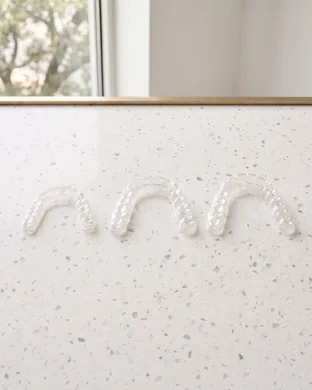
Why does an orthodontist shave between teeth (interproximal reduction)?
The American Association of Orthodontists’ FAQ answers in two sentences: “This procedure goes by many names: enamel stripping; interproximal reduction; slenderizing; reproximation and selective reduction. The goal is to remove some of the outer tooth surface (enamel) to acquire more space for your teeth.”
Interproximal reduction is done to make room for the teeth. The American Association of Orthodontists’ FAQ describes removing some of the outer tooth surface, the enamel, to acquire that space, and its glossary speaks of a small amount of enamel from between the teeth, removed to reduce their width. Whether a plan uses it, where and how much are set in the orthodontist’s treatment plan.
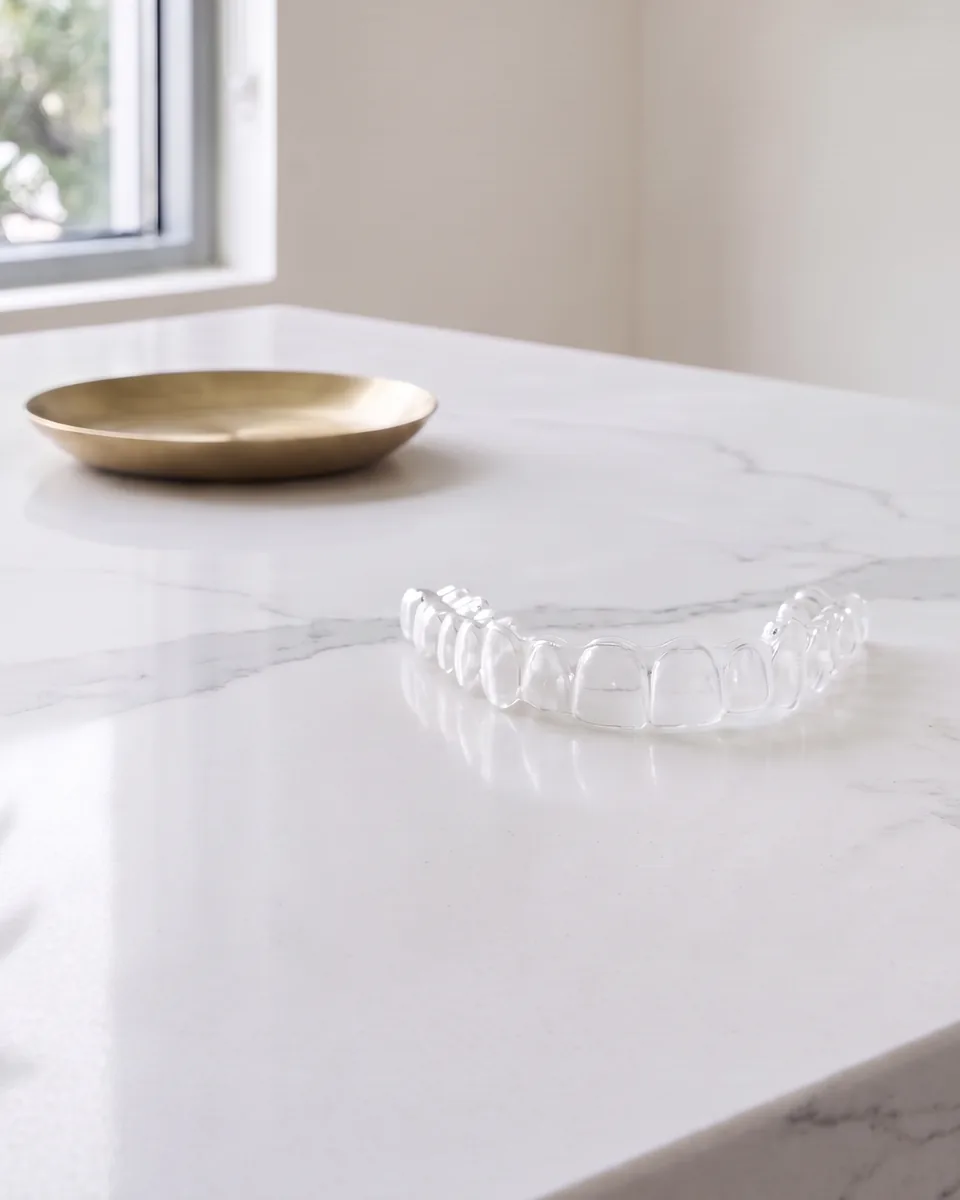
More space for the teeth: the AAO’s goal and definition
The American Association of Orthodontists (AAO) describes interproximal reduction (IPR) from two sides. Its glossary gives the means, “Removal of a small amount of enamel from between the teeth to reduce their width,” and its FAQ gives the reason, more space for the teeth.
Narrower teeth take up less room in the row, and that is where the space comes from. Making room matters where room is short, as with crowded teeth, which have an answer of their own. Where teeth have room to spare, the question turns into one about gaps between teeth.
How much enamel: Align’s figure and one study’s medians
Align Technology and one study each put a figure on how much enamel interproximal reduction involves, and the two figures measure different things. The AAO’s FAQ and glossary say some and a small amount, and give no figure.
Align, describing IPR in Invisalign® treatment in an August 2026 article on severe bite problems and crowding, puts the enamel removed at “typically less than half a millimeter per contact point,” a contact point being where two neighboring teeth meet. That is Align’s statement of what is typical, not a limit.
A 2024 study in the American Journal of Orthodontics and Dentofacial Orthopedics (Abasseri, Weir and Meade), of the digital treatment plans of 242 Invisalign patients of 11 orthodontists, found a median of 1.1 mm of interproximal reduction prescribed per patient in the initial plan and 0.6 mm in refinement plans, with the lower front teeth the most common site.
Those medians are per patient and not per tooth, and they describe that cohort alone: they do not say how many patients have interproximal reduction, what most patients have, or what your plan would involve.
Cavities and sensitivity after enamel reduction: two reviews and their limits
Two systematic reviews report no increase in cavities after interproximal reduction, each with a limit. A 2022 systematic review of eight clinical studies (Gómez-Aguirre and colleagues, Orthodontics and Craniofacial Research) says “no demineralization of the enamel, no increase in caries incidence, no periodontal changes or dental sensitivity was found after IPR,” rates the overall quality of those studies between low and very low, and calls for more and better trials.
A 2014 systematic review (Koretsi and colleagues, also in Orthodontics and Craniofacial Research), whose caries finding rests on four studies followed for 1 to 7 years, says “the occurrence of caries on surfaces previously treated with IER was the same as that on intact surfaces.” IER is that review’s name for the same procedure, and caries is the clinical word for cavities.
Those are findings about groups of patients, each with the limit stated beside it, so neither is a promise about your teeth.
Who decides: the orthodontist’s treatment plan
Interproximal reduction is decided in the orthodontist’s treatment plan, as the 2024 study by Abasseri, Weir and Meade and Align both describe it. The study’s digital plans record it as prescribed, and Align’s August 2026 article says “Your ClinCheck treatment planning software will map exactly where IPR is planned and how much space it creates.”
The AAO’s glossary says enamel does not regenerate, in an entry about enamel broken away or worn down by a bad bite, and by plain reasoning the enamel removed here does not grow back either. That makes these fair questions for your orthodontist before a plan goes ahead: whether it would be used at all, where, how much and why.
The clear aligners page covers how aligners move teeth once there is room, and you can browse other questions about orthodontic treatment from the hub.
Enamel regrowth and other names for the procedure
Does the enamel grow back after interproximal reduction?
No, by plain reasoning from the glossary of the American Association of Orthodontists, which says “If enamel breaks away from a tooth, or is worn away due to abnormal forces generated by a bad bite (or malocclusion), it is gone forever. Enamel does not regenerate.” That entry is about enamel lost to a bad bite, and it does not mention interproximal reduction.
Is enamel stripping the same thing as interproximal reduction?
Yes, in the FAQ of the American Association of Orthodontists, which lists enamel stripping, interproximal reduction, slenderizing, reproximation and selective reduction as names for one procedure. The AAO’s other names for it are on the glossary entry for interproximal reduction.
Sources
- American Association of Orthodontists, Orthodontic FAQs: Your Questions Answered (read November 6, 2026)
- American Association of Orthodontists, Glossary of Orthodontic Terms
- Align Technology (invisalign.com), Can Clear Aligners Treat Severe Bite Problems and Crowding?
- Abasseri, Weir and Meade, American Journal of Orthodontics and Dentofacial Orthopedics, 2024, Interproximal reduction in the refinement phase of Invisalign treatment: A quantitative analysis
- Gómez-Aguirre and colleagues, Orthodontics and Craniofacial Research, 2022, Effects of interproximal enamel reduction techniques used for orthodontics: A systematic review
- Koretsi and colleagues, Orthodontics and Craniofacial Research, 2014, Enamel roughness and incidence of caries after interproximal enamel reduction: a systematic review
Raise interproximal reduction at a consultation
Consultations are always free of charge. Fill in the request on this page for the Domain, Downtown or Westlake office.
Domain, Downtown and Westlake: Monday to Thursday, 8:15 a.m. to 5:00 p.m.Updated .