

Orthodontics for kids: the age-7 check-up, early (Phase 1) treatment and when to wait
We start seeing kids at age 7 to watch their growth.
The American Association of Orthodontists (AAO) recommends a child’s first orthodontic check-up when a problem is first recognized and no later than age 7, a latest age rather than one to wait for. Early (Phase 1) treatment, as the AAO describes it, takes place while a child is still growing and some baby teeth remain, to address a specific developing problem, and the AAO says it is not necessary for every child.
Age 7 in the AAO’s own words: the latest age for a first check-up
The American Association of Orthodontists (AAO) recommends age 7 as the latest age for a child’s first orthodontic check-up. Its patient page dated October 21, 2026 gives the recommendation in full: “The American Association of Orthodontists recommends that children have their first check-up with an orthodontist when an orthodontic problem is first recognized and no later than age 7.”
The same page adds: “Age 7 is the recommended latest age for a first check-up, not an age that parents must wait to reach.” If you or your child’s dentist notices something unusual earlier, the AAO says an evaluation can be scheduled sooner.
Seven is chosen, the AAO explains, for what the mouth holds at that age: “By around age 7, many children have a combination of baby and permanent teeth. That allows an orthodontist to evaluate how the teeth, bite, and jaws are developing, including problems that may not be easy for parents to see.” So the check-up waits neither for a visible problem nor for the last baby tooth.
A child’s first orthodontic visit, as the AAO describes it
For many children, the AAO says, a first orthodontic visit is primarily an evaluation, not the start of treatment: “The orthodontist will look at how your child’s teeth and jaws are developing and how the upper and lower teeth fit together. The visit gives you an opportunity to discuss any concerns and learn whether an orthodontic problem is present.”
The AAO’s FAQ says the orthodontist or a staff member may take photographs of a child’s teeth and face, and that x-rays are necessary for an accurate diagnosis: “They reveal what could otherwise only be guessed.” A panoramic x-ray, it says, “may be taken at a first exam, or may be postponed until closer to the time that its recommended treatment begins.” Which records a child’s visit at Kunik Orthodontics includes is a question for the office; a separate answer describes a first orthodontic consultation for any patient.
No referral is needed to ask for that visit. The AAO says: “You do not need to wait for your child’s dentist to provide a referral before scheduling an orthodontic evaluation.” The practice says the same: You do not need a referral.
Watching instead of treating: why many children seen at 7 need no treatment yet
Many children seen at 7 need no treatment yet, as the AAO says: “That does not mean every 7-year-old needs braces. In fact, many children who see an orthodontist at an early age do not need treatment right away.” After an early evaluation, the AAO says, an orthodontist may determine that:
- No orthodontic treatment is expected to be necessary.
- Treatment may be beneficial later, so the child’s growth and tooth development should be monitored.
- A developing problem may benefit from early orthodontic treatment.
The AAO’s FAQ, in an answer published on aaoinfo.org in 2022, adds: “Only a few orthodontic problems will need correction around age 7.” When a problem is found, it says, the orthodontist is likely to wait and see, checking growth and development periodically.
If treatment is not needed yet, the AAO says, the orthodontist may recommend periodic check-ups to monitor growth and tooth eruption, and its page on early treatment says that for a child in this follow and monitor group, the orthodontist “can watch growth patterns and tooth eruption timing and recommend treatment only if and when it becomes beneficial.” How often a watched child is seen is decided at the visit.
The AAO’s two-phase page adds: “For many children, a single phase of comprehensive orthodontic treatment is still the right path, and an orthodontist can help you understand which plan fits your child’s needs.” Dr. Kunik’s approach to early treatment is very conservative.
Early (Phase 1) treatment: what it is for, and the problems the AAO names
The AAO defines Phase 1 treatment by its timing: “Phase 1 orthodontics, also called early or interceptive orthodontic treatment, is treatment that takes place while a child is still growing and some baby teeth are still present.” Its purpose is “not simply to make teeth look straighter at a younger age,” the AAO says, but to address a specific developing problem at a time when treatment may be beneficial.
The AAO’s examples of concerns for which an orthodontist may recommend early treatment include an underbite, a crossbite, significant crowding, excessive spacing, extra or missing teeth, teeth that do not meet normally or at all, certain eruption problems, and thumb, finger or pacifier habits that are affecting the teeth or jaw growth. The AAO also says Phase 1 treatment is not necessary for every child.
The AAO’s two-phase page says when a two-phase plan is usually considered: “Two-Phase treatment is usually considered only when an orthodontist determines your child is likely to have a severe malocclusion or jaw problem, or damage to permanent teeth, and that Phase One treatment has a high likelihood of reducing that severity and risk.”
The four early-treatment tools on the practice’s list, in their sources’ words
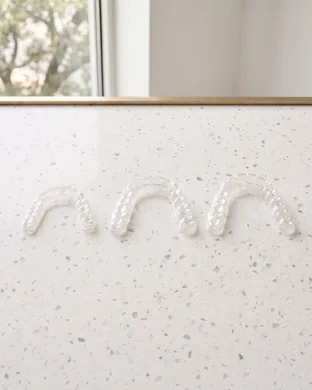
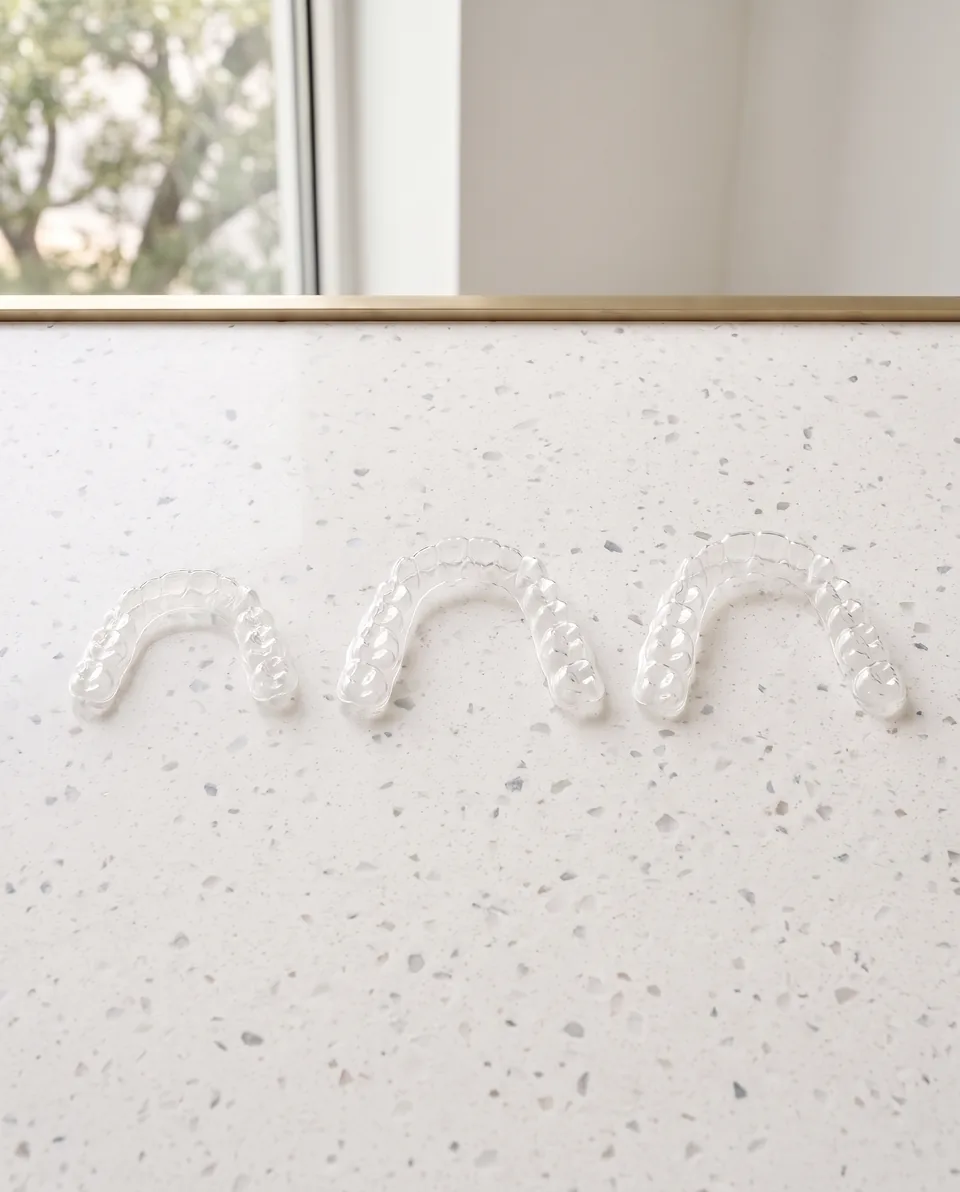
Four tools are on the practice’s list for early treatment, and one, Invisalign® First aligners, is made by Align Technology. In the practice’s own words, the list is expanders, Invisalign First, braces, and habit appliances. Whether a child needs any of them, and which, is Dr. Kunik’s decision at the examination.
Expanders
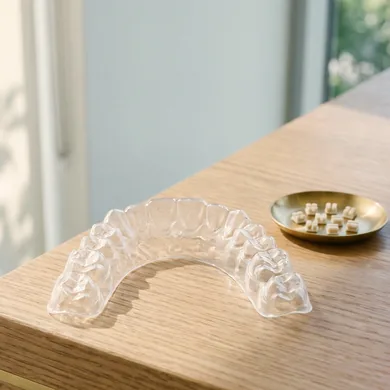
Palatal expanders widen the upper jaw, as the AAO describes them. The AAO says “some growing patients may benefit from a palatal expander,” but that “Not every patient will need a palatal expander”: expanders are typically reserved for severe malocclusions or for assisting jaw development. Among the most common issues they treat, it lists a crossbite, severe crowding and impacted teeth, where a narrow jaw can block teeth from coming in. For a back crossbite, a 2021 Cochrane review describes treatment as expanding the upper jaw with a fixed appliance, such as a quad-helix, or a removable one, such as an expansion plate, and the AAPD’s crossbite guidance says skeletal expansion with fixed or removable palatal expanders “can be utilized until midline suture fusion occurs.”
Invisalign First aligners
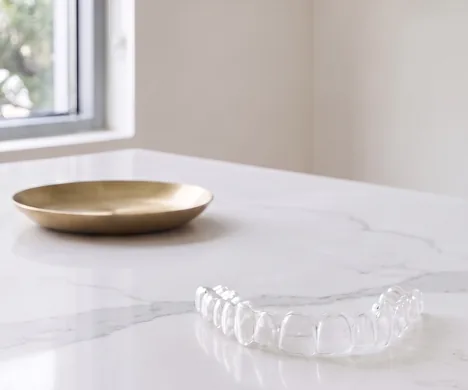
Align says Invisalign First aligners are customized for children between 6 and 10 years old and built to fit smaller teeth, and describes the product as a “series of customized, removable clear aligners that guide teeth and arch development over time.” In a 2026 meta-analysis in the Angle Orthodontist (nine studies, eight pooled), Invisalign First aligners in the mixed dentition achieved a pooled 65 percent of planned dental arch expansion in the upper jaw, on low-certainty evidence, and 71 percent in the lower, on moderate-certainty evidence. In a 2026 systematic review of upper-jaw expansion in growing patients, in Progress in Orthodontics (15 studies, seven pooled, mostly retrospective), the authors concluded that aligners produce significantly less skeletal widening than conventional expanders, and asked for caution because of a moderate risk of bias. Which problems the aligners are used for at Kunik Orthodontics is a question for the consultation.
Braces
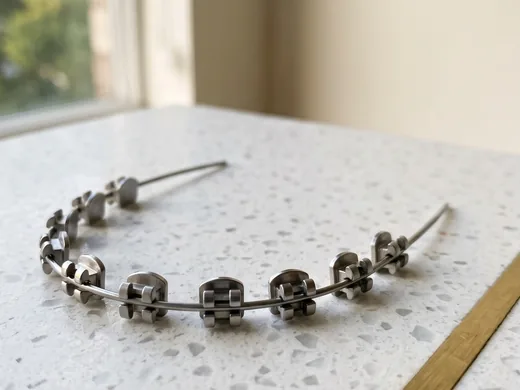
Braces in early treatment can mean braces on some teeth only: the AAO says some children “may have limited braces or another appliance designed to address a particular problem,” and its two-phase page lists braces on certain teeth “to correct specific alignment concerns and support healthier eruption patterns.” The braces page explains how metal and ceramic braces work.
Habit appliances
Habit appliances appear in the AAO’s FAQ, which says some patients “may need intervention to stop a thumb- or finger-sucking habit” and that this is sometimes treated with habit appliances. For thumb and finger sucking, a 2015 Cochrane review of six trials, all at high risk of bias, that recruited 252 children found low-quality evidence that appliances, a palatal crib or a palatal arch, and psychological interventions such as positive and negative reinforcement are effective at improving sucking cessation.
One phase or two: the Class II and crossbite reviews, with their grades
Cochrane’s Class II and crossbite reviews studied different problems with different comparisons. The AAO’s two-phase page frames Phase One this way: “By guiding a child’s jaw as it grows, it reduces the severity of malocclusions, allowing Phase Two to build on the existing foundational treatment to further correct and fine-tune your child’s bite.”
For prominent upper front teeth, a Class II bite, a 2018 Cochrane review compared two-phase treatment begun at seven to 11 years old with one phase in adolescence at around 12 to 16. On evidence of low to moderate quality, the 2018 Cochrane review concluded that early treatment for children with prominent upper front teeth is more effective than late treatment at reducing new injuries to those teeth, adding: “There appear to be no other advantages of providing early treatment when compared to late treatment.”
In the 2018 Cochrane review’s trials of early functional-appliance treatment, the early group had less overjet after the first phase, but once both groups had finished there was no difference in final overjet, a finding graded low-quality evidence. Cochrane rates the Class II review’s evidence low for most comparisons and outcomes, and says “further research is needed and may change the findings.”
For back (posterior) crossbites, a 2021 Cochrane review’s findings in children compare appliances with observation, not early treatment with later treatment. That 2021 Cochrane review found high-certainty evidence that, in children aged 7 to 11, the quad-helix (three studies, 149 participants) and expansion plates (three studies, 148 participants) were each beneficial for correcting a posterior crossbite compared with observation, and it rates its confidence high to moderate for its main results and low for other comparisons.
The AAPD, reading the randomized trials, writes that “Class II malocclusion can be corrected effectively with either a single or 2-phase regimen,” and that response to growth-modification treatment varies substantially, with no reliable predictors of a favorable growth response found. So the evidence depends on the problem, and the first question at the examination is which problem, if any, a child has.
An underbite or a crossbite while a child is still growing
An underbite and a crossbite are both on the AAO’s list of concerns that may call for early treatment, and two answers go further: what an underbite is and how it is treated, and when a crossbite should be treated. For an underbite, the AAO’s article says: “For children who are still growing, early treatment can be effective.”
A 2024 Cochrane review of prominent lower front teeth (Class III) identified 29 randomized trials, all at high risk of bias, in 1,169 children aged five to 13 at the start of treatment, and found moderate-certainty evidence that, compared with no treatment, non-surgical treatments such as the facemask improved the bite and jaw relationship immediately after treatment. In the 2024 Cochrane review’s one long-term study, the facemask’s benefit was smaller after three years and appeared lost by six, findings the authors hold with low confidence.
A crossbite of one or more front teeth differs: the AAPD says a simple anterior crossbite of dental origin, told apart from a Class III skeletal problem, “can be aligned as soon as the condition is noted” if enough space is available.
After Phase 1: the resting period, a second phase, and the last baby teeth
For most children Phase 1 ends in a pause, in the AAO’s account: “After Phase One ends, most children enter a resting period before Phase Two begins. That break gives the jaw and teeth time to continue natural growth and allows remaining permanent teeth to erupt.” The AAO says the orthodontist uses the break to evaluate how the Phase One changes are holding and to plan Phase Two.
A second phase may follow: the AAO’s page of October 21, 2026 says “Some children later have a second phase of treatment after more or all of their permanent teeth have erupted.” That phase often uses braces or clear aligners, its two-phase page says; the clear aligners page sets out how Invisalign clear aligners work.
The mixed dentition then gives way to what the AAPD’s 2024 guideline calls the adolescent dentition, from approximately age 11 to 12, when all permanent teeth except the third molars may be erupted or erupting. The teen years are on the page about orthodontics for teens.
Deciding on a Phase 1 plan: questions to ask, and a second opinion
A parent asked to agree to Phase 1 treatment can bring the AAO’s questions, from its two-phase page: “Ask your child’s orthodontist how Phase One supports Phase Two, what changes they are targeting now, and what they expect to address later.” Three more follow from the evidence:
- Which problem is developing, and is it on the AAO’s list of concerns for early treatment?
- Which tool is proposed, and what does the evidence say for that problem?
- What would watching growth for now, rather than treating, change?
If the answers leave the reason for treating now unclear, a second opinion before Phase 1 begins is a reasonable step. Paying for treatment is taken up on the page about insurance and payment. The next step is a consultation at one of the practice’s Domain, Downtown and Westlake offices.
What parents ask about a child’s first years with an orthodontist
Will my seven-year-old get braces at the first visit?
No. A first check-up is not the start of treatment, and the American Association of Orthodontists’ FAQ draws that line: “Remember, there is a difference between an orthodontic check-up and actually starting orthodontic treatment.” If a developing problem could benefit from early treatment, the AAO says, the orthodontist can discuss the options, goals and timing with you, and whether anything starts is decided with Dr. Kunik after the examination.
What if my child is already older than 7?
A child older than 7 can still have a first check-up. The American Association of Orthodontists’ FAQ, in an answer published on aaoinfo.org in 2022, says “If your child is older than 7, it is not too late for a check-up.” The same answer says many patients begin treatment between the ages of 9 and 16, depending on their physiological development and treatment needs. When your child might start is decided at the examination.
When does a thumb or pacifier habit start to matter?
The sources give different ages. The American Association of Orthodontists’ FAQ, in an answer published on aaoinfo.org in 2022, points to age 4: “If your child sucks a thumb, finger, pacifier, lips, or fabric such as clothing or a blanket beyond age 4, there could be unwanted consequences.” Teeth may be pushed forward, it says, an open bite may develop, and bone may become misshapen. The AAO’s 2024 page on pacifiers says children often stop between 2 and 4, and the American Academy of Pediatric Dentistry’s 2024 guideline says it has been suggested that early dental visits give parents guidance to help children stop by 36 months or younger.
Do the baby teeth have to fall out before treatment can start?
No. The American Association of Orthodontists describes Phase 1 treatment as treatment that takes place while a child is still growing and some baby teeth are still present. The AAO adds that Phase 1 treatment is not necessary for every child and that many orthodontic problems can and should wait until later. Whether one child starts before the last baby tooth falls out is decided at the examination.
Sources
- American Association of Orthodontists, Can You Get Braces With Baby Teeth? What Parents Need to Know
- American Association of Orthodontists, What Is Two-Phase Orthodontic Treatment?
- American Association of Orthodontists, What Are the Benefits of Early Orthodontic Treatment?
- American Association of Orthodontists, What is a Palatal Expander, and What is it Used For?
- American Association of Orthodontists, Pacifiers and Teeth: How Do Pacifiers and Thumb Sucking Impact Dental Development?
- American Association of Orthodontists, Underbite: Causes, Symptoms, and Treatment Options
- American Association of Orthodontists, Glossary of Orthodontic Terms
- American Association of Orthodontists, Orthodontic FAQs: Your Questions Answered (FAQ listing, page 20)
- American Association of Orthodontists, Orthodontic FAQs: Your Questions Answered (FAQ listing, page 21)
- American Association of Orthodontists, Orthodontic FAQs: Your Questions Answered (FAQ listing, page 23)
- American Association of Orthodontists, FAQ record 5154: Why does the AAO say that kids should see an orthodontist for a check-up no later than age 7?
- American Association of Orthodontists, FAQ record 5156: What if my child is older than 7, is it too late for a check-up?
- American Association of Orthodontists, FAQ record 5183: My child sucks his thumb/finger/pacifier. Should I be concerned?
- American Academy of Pediatric Dentistry, Management of the Developing Dentition and Occlusion in Pediatric Dentistry
- American Dental Association, MouthHealthy, Permanent Tooth Development (chart)
- Batista and others, Cochrane Database of Systematic Reviews, 2018, Orthodontic treatment for prominent upper front teeth (Class II malocclusion) in children and adolescents, abstract
- Batista and others, Cochrane Database of Systematic Reviews, 2018, at PubMed Central, Orthodontic treatment for prominent upper front teeth (Class II malocclusion) in children and adolescents, full text
- Ugolini and others, Cochrane Database of Systematic Reviews, 2021, Orthodontic treatment for posterior crossbites, abstract
- Borrie and others, Cochrane Database of Systematic Reviews, 2015, Interventions for the cessation of non-nutritive sucking habits in children, abstract
- Owens and others, Cochrane Database of Systematic Reviews, 2024 (PubMed record), Orthodontic treatment for prominent lower front teeth (Class III malocclusion) in children
- Serafin and colleagues, The Angle Orthodontist, 2026 (PubMed record), Predictability of clear aligners in achieving planned dental arch expansion during mixed dentition: a systematic review and meta-analysis
- Fonseca Planells and colleagues, Progress in Orthodontics, 2026 (PubMed record), Effectiveness of clear aligners for maxillary expansion in growing patients: a systematic review and meta-analysis
- Align Technology (invisalign.com), Invisalign Treatment for Kids
- Align Technology (invisalign.com), Invisalign First clear aligners for kids: early orthodontic treatment explained
Ask for your child’s first orthodontic check-up
Consultations are always free of charge. In the request below, choose My child, then pick an office.
Monday to Thursday, 8:15 a.m. to 5:00 p.m. Closed 1:00 to 2:15 p.m. for lunch. Downtown is by appointment only, on Thursdays.Updated .