

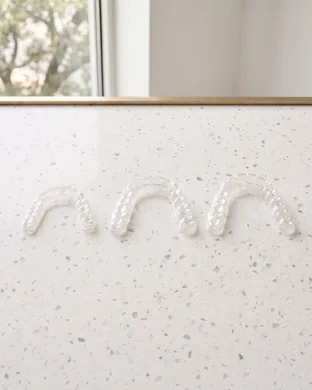
Can you wear clear aligners only at night?
The FAQ of the American Association of Orthodontists says of aligners, “They can only move teeth when they are in your mouth.” This answer sets that sentence beside the published wear figures and a retainer worn only at night.
Not by the hours the American Association of Orthodontists and Align Technology publish. The AAO’s FAQ gives at least 22 hours a day and says aligners can only move teeth when they are in the mouth, and Align’s October 2026 article gives 20 to 22 hours a day, including while you sleep. The AAO’s night-only line is about a retainer after braces, and an orthodontist sets a patient’s own hours.
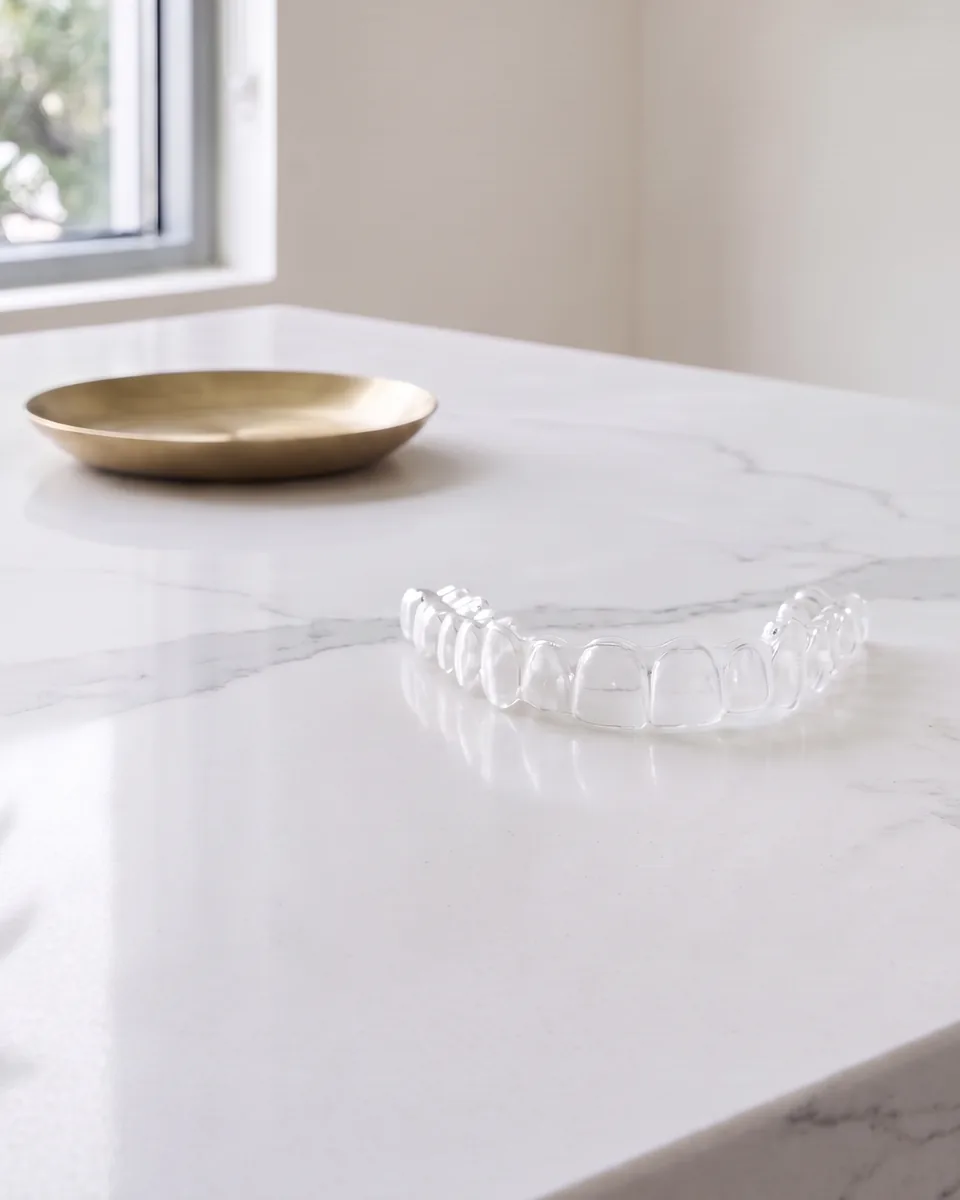
Time in the mouth: the AAO’s two lines on aligners
The American Association of Orthodontists (AAO) ties aligner movement to time in the mouth. The AAO’s FAQ says of aligners, “They can only move teeth when they are in your mouth,” and its January 2019 article comparing braces and clear aligners says, “Aligners can’t work unless they are in the mouth.”
Neither line names night-only wear. By the AAO’s account, time out of the mouth is time the aligners are not moving teeth.
The wear figures the AAO and Align publish
The published hours differ: the AAO’s FAQ says “Aligners need to be worn at least 22 hours a day,” and Align Technology, maker of Invisalign® clear aligners, says in an October 2026 article to wear them 20 to 22 hours per day, including while you sleep.
A night’s sleep covers only part of either figure. The hours for your own aligners are your orthodontist’s instruction, so read these as the AAO’s and Align’s figures and not as a prescription. The figures on their other pages are set side by side on the practice’s clear aligners page.
What inconsistent or reduced wear can do to an aligner plan
Inconsistent wear is a risk the AAO names for clear aligners. The AAO’s June 2024 article on clear aligner therapy says, “Since they’re removable, inconsistent aligner wear can hinder your progress, extending the length of treatment or compromising the results.”
Align’s October 2026 article on its app, writing about teens, says “as wear time decreases, treatment can slow down.” Neither line gives a number for how much wear can be missed or how much time it adds.
The AAO’s FAQ says “Your orthodontist can evaluate how your aligners fit and whether your teeth are moving as planned. If treatment is not tracking as expected, aligner wear may be one factor they consider.” Wear can be one part of what decides how long treatment takes, a wider question answered separately.
A retainer worn at night is a different appliance
Night-only wear does appear in the AAO’s guidance, as a retainer schedule after braces. The AAO’s September 2026 article on what follows braces says, “Over time, you may be able to transition to wearing your retainer only at night, depending on your orthodontist’s recommendations and how stable your teeth are.” That line is about a retainer once braces are off, so it sets no hours for an aligner.
The AAO’s glossary gives the two appliances different jobs: aligners are “Clear, thin, removable trays that are formed to fit an individual’s teeth and are used to straighten teeth,” and “A retainer is fitted to upper and/or lower teeth to hold them in their finished positions.” The AAO’s October 2026 article on tight retainers says “A retainer’s main purpose is to maintain the positions achieved through orthodontic treatment.”
Which appliance you wear, and on what schedule, comes from your orthodontist, and the full account of retainer wear sits on the practice’s retainers page. Other aligner questions are listed in the questions hub.
More on aligners, sleep and shorter wear
Do clear aligners stay in while you sleep?
Yes, by Align Technology’s instructions for its own aligners. Align’s April 2024 guide calls sleeping with them necessary because of its figure of 20 to 22 hours daily. The hours for your own aligners come from your orthodontist.
Is a night-only retainer the same thing as an aligner?
No, not in the glossary of the American Association of Orthodontists. The glossary describes a retainer as an appliance worn after braces are removed or aligner therapy is complete, to hold the teeth in their finished positions, and describes aligners as removable trays used to straighten teeth.
Has any study tested wearing aligners for fewer hours?
At least one has, with aligners other than Invisalign aligners. A 2026 retrospective study in the Journal of Orofacial Orthopedics (Cremonini and colleagues), of 40 adults selected on specific inclusion criteria, compared another maker’s 3D-printed aligner on a 12 hours a day protocol with the same maker’s thermoformed aligners on a 22 hours a day protocol, and found no statistically significant difference in accuracy for the tipping and rotation it measured. The abstract reports no treatment time and no outcome beyond accuracy, so it does not say the shorter protocol worked, took as long or gave the same result. The study sets no schedule for any other aligner and does not change the AAO’s or Align’s instructions.
Sources
- American Association of Orthodontists, Orthodontic FAQs: Your Questions Answered (read November 6, 2026)
- American Association of Orthodontists, Aligners vs. Braces: A Comparison
- Align Technology (invisalign.com), What to expect at your first Invisalign treatment consultation
- Align Technology (invisalign.com), What are Invisalign aligners and how they are different from braces
- American Association of Orthodontists, Clear Aligner Therapy: How Transparent Aligners Work
- Align Technology (invisalign.com), How the Invisalign app keeps treatment on track
- American Association of Orthodontists, Glossary of Orthodontic Terms
- American Association of Orthodontists, What to Expect After Your Braces Come Off
- American Association of Orthodontists, My Retainer Feels Tight or Doesn’t Fit. Should I Force It?
- Cremonini and colleagues, Journal of Orofacial Orthopedics, 2026, Accuracy of orthodontic movement with nocturnal three-dimensionally printed and thermoformed aligners: Retrospective cohort study comparing two different treatments protocols
Bring the question of aligner wear hours to a consultation
Consultations are always free of charge. You do not need a referral. Ask for a time with a consultation request from this page, at the Domain, Downtown or Westlake office.
Domain, Downtown and Westlake: Monday to Thursday, 8:15 a.m. to 5:00 p.m.Updated .