

What causes crowded teeth, and how are they straightened?
Every plan to straighten crowded teeth starts with where the missing room will come from, so that is where this answer starts too.
Crowded teeth have too little space, and they are straightened by making room, then moving them with braces or aligners. The American Association of Orthodontists names causes including oversized teeth, early or late loss of baby teeth and too little room in the jaw. Room can come from widening a narrow upper jaw during growth, removing a little enamel between teeth, or removing a tooth after a full space analysis.
Three ways to make room for crowded teeth
Straightening crowded teeth starts with a decision about space, because crowding is a shortage of room, and teeth cannot line up in room that is not there. Between them, the American Association of Orthodontists (AAO) and the American Academy of Pediatric Dentistry (AAPD) describe three ways of making it, and which one fits is the decision a patient with crowded teeth actually faces.
- Widening the upper jaw. The AAO says “palatal expansion can widen the upper jaw, reducing crowding in abnormally narrow arches,” that a palatal expander is ideally used while a patient is still growing, and that in younger patients expansion may reduce the need for tooth removal.
- Removing a little enamel. The AAO’s glossary defines interproximal reduction as the “removal of a small amount of enamel from between the teeth to reduce their width,” so the teeth take up less of the arch.
- Removing a tooth. The AAPD says removing baby or permanent teeth to relieve crowding “should not be undertaken without a comprehensive space analysis,” and the AAO adds that “not every crowded smile requires an extraction, so the decision typically depends on factors such as the patient’s bite, jaw size, tooth position, facial structure, and overall treatment goals.”
If a tooth has to come out, the AAO says the orthodontist may send the patient to an oral surgeon first, before braces or aligners are placed. The extraction belongs to a dentist or an oral surgeon; moving the teeth into the new room belongs to the orthodontist.
Overlap, twist and push: crowding in the AAO’s definition
The AAO’s article on common bite problems defines crowding plainly: “Crowding refers to a condition in which there is insufficient space for the teeth. This lack of space causes the teeth to overlap, twist, or be pushed to the front or back.” Each of those results asks something different of a plan. Overlapping teeth need room, twisted teeth need turning back into line, and teeth pushed forward or back need moving into the arch.
What leaves teeth short of room
The AAO traces crowding to “oversized teeth, premature or late loss of baby teeth, poor dental habits, or inadequate space in the jaw.” A Cochrane review of orthodontic treatment for crowded teeth in children (Turner and colleagues, 2021) adds that “early loss of baby teeth as a result of tooth decay or trauma, can lead to crowded permanent teeth.”
The cause matters to the plan, because the ways of making room answer different shortages. Expansion answers a narrow upper jaw in a patient who is still growing, while enamel reduction and extraction change how much of the arch the teeth themselves take up.
Crowding found in childhood: treat early or watch
Whether crowding found in a child should be treated early is where the sources part ways. Significant crowding is on the AAO’s list of concerns an orthodontist may recommend treating early. The AAPD reports a systematic review of children who started between ages 7 and 9 and were followed for 4 to 6 years, in which crowding of the lower front teeth tended to decrease over time; that review “cautioned against early orthodontic treatment due to self-correction; however, there was great variability in the data, and several patients showed increased crowding over time.”
Cochrane’s crowding review adds that one study found removing children’s lower baby canines had more effect on crowding after a year than no treatment, alongside a reduction in arch length, and it rates its evidence as very low certainty. Removing a baby tooth for crowding is a dentist’s or an oral surgeon’s procedure, and the AAPD ties it to a comprehensive space analysis.
Dr. Kunik’s approach to early treatment is very conservative. Whether one child’s crowding is watched or treated early is a question for that child’s consultation.
Braces or aligners for crowded teeth, in the reviews’ words
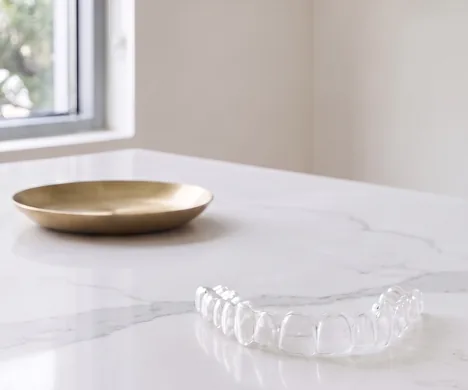
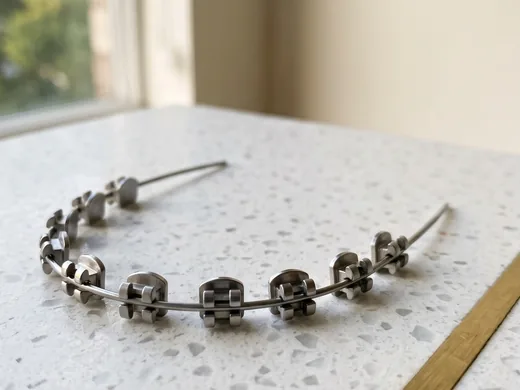
The practice’s routes are braces, Invisalign® treatment and the Hybrid, and the research below shows why the choice among them for crowded teeth is made case by case.
The AAO’s aligners page lists cramped or crowded teeth among the most common conditions aligners treat, and the AAO’s 2024 article on how transparent aligners work sets the limit: “Clear aligners may not work as predictably for severe malocclusions, significant tooth rotations, and large gaps. Traditional braces may offer more precision in these cases.”
Rotation is where crowding and aligners meet, because crowded teeth twist. A 2021 meta-analysis (Koletsi and colleagues, Journal of Orthodontics) concluded that “prediction of rotational tooth movements with aligner treatment does not appear accurate, especially for canines,” and that choosing patients and bites for aligner treatment remains challenging.
A 2025 meta-analysis (Alhafi and colleagues, European Journal of Orthodontics) found no significant difference in treatment quality between aligners and fixed appliances in non-extraction cases, and higher quality with fixed appliances where teeth were removed, a difference its authors put down to better control of tooth movement. Its conclusion is that both kinds of appliance reach treatment goals and that the complexity of the case and the patient’s compliance should decide between them, with the caveat that mixed studies and short follow-up limited how strong its conclusions could be.
Those findings describe groups of patients, not one mouth, and which appliance suits a particular crowded smile is decided at the consultation. The mechanics of Invisalign clear aligners, and the cases they suit and do not, have a page of their own.
The Hybrid: braces and aligners in one plan
Between braces and aligners sits the practice’s Hybrid treatment, which it describes in two phases, The Braces Phase and The Invisalign Phase. We may adjust your braces, provide new aligner sets, or transition between methods as your treatment progresses. The orthodontic literature has a general name for that kind of combination: Kravitz and colleagues, writing in the Journal of Clinical Orthodontics in 2023, describe hybrid aligner treatment as “the combination of clear aligners with other devices, including fixed appliances.”
Where the room comes from is settled at a consultation
The questions this page leaves open are the ones to bring to a consultation: where the room will come from, whether braces, Invisalign treatment or the Hybrid suits the teeth, and whether a tooth needs to come out first, which would be a dentist’s or an oral surgeon’s procedure. For a crowding plan already written somewhere else, we are happy to be a second opinion.
Each of the other bite problems is taken up separately in the practice’s questions and answers.
Questions that follow from crowded teeth
Do crowded teeth get worse with age?
Cochrane’s 2021 review of orthodontic treatment for crowded teeth in children says “crowding tends to increase with age, especially in the lower jaw.” In younger children the picture is less simple: the AAPD reports a review of children who started between ages 7 and 9 in which crowding of the lower front teeth tended to decrease over the following 4 to 6 years, though with great variability and several children whose crowding increased. Which way one mouth is heading is a question for that patient’s consultation.
Can wisdom teeth cause crowding?
The evidence is mixed. In Cochrane’s crowding review, one study found that “extracting wisdom teeth did not seem to reduce crowding any more than leaving them in the mouth.” Reviews of crowding after orthodontic treatment pull different ways: a 2023 review found there seemed to be no clear link between lower wisdom teeth and later front-tooth crowding, a 2026 review, working from very low certainty evidence, found no consistent sign that wisdom teeth meaningfully affect it, and a 2024 meta-analysis judged that lower wisdom teeth may contribute to crowding of the lower teeth. Whether a wisdom tooth comes out is decided with the dentist or an oral surgeon, and the braces page sets out the evidence on wisdom teeth and braces.
Sources
- American Association of Orthodontists, 7 Common Types of Bite Problems and Their Orthodontic Solutions
- American Association of Orthodontists, Early Orthodontic Care at Age 7: A Path to Cost-Effective Treatment
- American Association of Orthodontists, Glossary of Orthodontic Terms
- American Association of Orthodontists, Dentist vs. Orthodontist vs. Oral Surgeon: What’s the Difference?
- American Association of Orthodontists, Can You Get Braces With Baby Teeth? What Parents Need to Know
- American Association of Orthodontists, Clear Aligners
- American Association of Orthodontists, Clear Aligner Therapy: How Transparent Aligners Work
- American Academy of Pediatric Dentistry, Management of the Developing Dentition and Occlusion in Pediatric Dentistry
- Turner et al., Cochrane Database of Systematic Reviews, 2021 (PubMed record), Orthodontic treatment for crowded teeth in children
- Koletsi et al., Journal of Orthodontics, 2021 (PubMed record), Predictability of rotational tooth movement with orthodontic aligners comparing software-based and achieved data: A systematic review and meta-analysis of observational studies
- Alhafi et al., European Journal of Orthodontics, 2025 (PubMed record), Quality and stability of orthodontic treatment outcomes with clear aligners versus fixed appliances: a systematic review and meta-analysis
- Borzabadi-Farahani, Frontiers in Dental Medicine, 2026 (PubMed Central), Clear aligner therapy: a scoping review of treatment prediction, clinical effectiveness, and limitations
- Kravitz et al., Journal of Clinical Orthodontics, 2023, Overview: Hybrid Aligner Treatment
- Lyros et al., Dental Journal (Basel), 2023 (PubMed record), The Effect of Third Molars on the Mandibular Anterior Crowding Relapse: A Systematic Review
- Amberg et al., Clinical Oral Investigations, 2026 (PubMed record), Wisdom teeth removal and anterior alignment stability after orthodontic treatment: a systematic review
- Palikaraki et al., The Angle Orthodontist, 2024 (PubMed record), Effect of mandibular third molars on crowding of mandibular teeth in patients with or without previous orthodontic treatment: a systematic review and meta-analysis
Bring your crowded teeth to a consultation
Consultations are always free of charge. You do not need a referral. Use the consultation request on this page, or call whichever office is on your way.
Domain, Downtown and Westlake: Monday to Thursday, 8:15 a.m. to 5:00 p.m.Updated .