

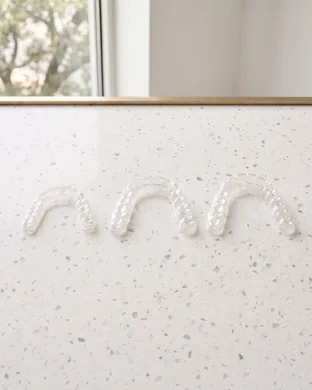
Invisalign® treatment: how clear aligners move teeth, and what they can and cannot do
Your Invisalign aligners are fully removable for meals, giving you complete flexibility for eating.
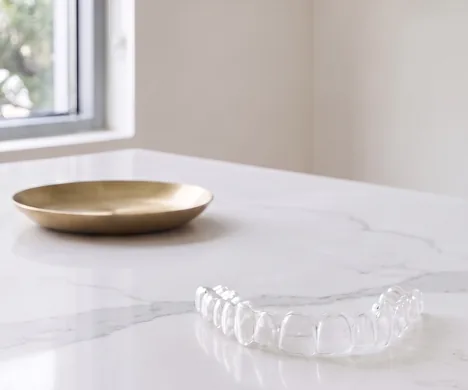
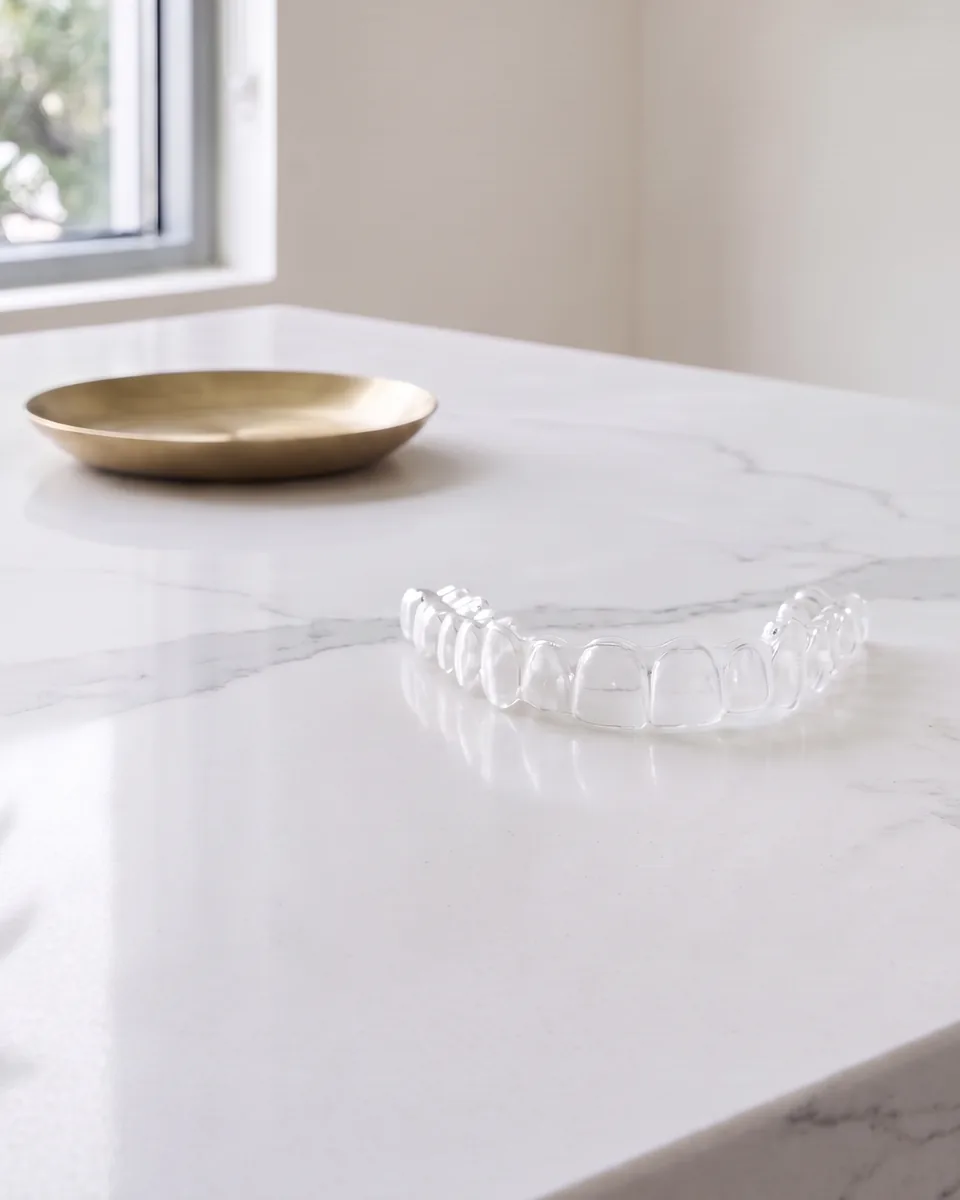
Clear aligners are a series of custom-formed trays, each made a fraction of a millimeter off the teeth’s current position so that, worn as prescribed, the teeth move to fit it, according to the American Association of Orthodontists. The AAO lists crowding, gaps, overbite, underbite, open bite and crossbite among the conditions aligners commonly treat, and says they may not work as predictably for severe malocclusions, significant rotations and large gaps.

2026 Invisalign® Sapphire Provider, a designation of Align TechnologyRead at Align’s Doctor Locator on October 31, 2026
What Align says the Invisalign system is made of
Align Technology, the company behind Invisalign clear aligners, describes its system as a series of custom aligners worn one after another, made from its own aligner material and, where a plan calls for them, pushing against small tooth-colored attachments bonded to the teeth.
On the material, Align says the aligners are made from SmartTrack aligner material, which it calls “a proprietary multi-layer material designed exclusively for the Invisalign system”.
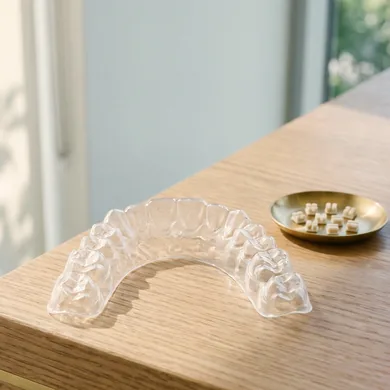
On attachments, Align describes SmartForce attachments as “small tooth-colored shapes that are attached to your teeth before or during your Invisalign treatment” and likens them to handles, “giving aligners something to gently push on.” Align also says not everyone who uses Invisalign clear aligners will need them, and notes that “attachments on your front teeth may be easier to see than attachments on your molars.”
For you, the point is that the trays are only part of the treatment: the plan decides what each tray does, including whether attachments are needed and on which teeth.
How a series of aligners moves teeth through bone
Clear aligners move teeth by fitting slightly off on purpose. The American Association of Orthodontists (AAO) explains in its FAQ that a new set will not be an exact fit at first: “They’ll be off by just a fraction of a millimeter”, and that is the idea, “so that your teeth move to fit the aligner.”
The movement itself is the same biology for aligners and braces. A 2022 AAO news release explains that pressure from any orthodontic appliance moves a tooth: “The pressure causes necrosis (death) of the supporting structure around the tooth, allowing the tooth to move within its alveolus (bone socket); and bone then reforms around the tooth.” The appliances differ in how that pressure reaches each tooth.
Attachments are Align’s answer to how a smooth tray gets a grip. Align says attachments act as “anchor points that help the aligners grip your teeth” for more complex movements, naming rotations and extrusions. That is Align’s account of their purpose, not a promise that a given rotation will go to plan: reviews summarized below found rotations, especially of rounded teeth and canines, hard for aligners to control and to predict.
Wear time is where the mechanism meets your day. Align’s April 2026 patient article tells patients to wear their aligners 20 to 22 hours a day, removing them only for eating, drinking anything other than water, and brushing. The AAO’s FAQ says aligners need to be worn at least 22 hours a day and adds: “They can only move teeth when they are in your mouth.”
The wear figures differ by publisher and by page. The AAO’s aligners page says each aligner is typically “worn for 1 week at a time, at least 22 hours a day”, and the AAO’s September 2026 article says aligners only work if worn as prescribed, usually 20 to 22 hours a day. Align’s April 2026 article says patients typically switch to a new set “weekly or biweekly, depending on your provider’s instructions”. Your own hours and tray changes are your orthodontist’s instructions for your plan, so bring that question to the consultation.
Records, iTero digital scans and the digital plan behind each tray
A series of aligners is built from records and a diagnosis. The AAO’s 2024 article on clear aligner therapy says: “Before starting treatment, your orthodontist will check your teeth and jaws using X-rays, photos, and digital scans.” The doctor then gives a diagnosis and designs the plan in the aligner software, which, in the same article’s words, “details which tooth moves where and in what order.”
The X-rays are there because a scan sees only surfaces. The AAO says “X-rays are the only way to see underneath the gums” and that digital scans and photographs cannot see under the surface of the gums.
For the scan, Align’s page on how its treatment works says your doctor will “create a detailed, 3D scan of your current smile and map out the custom treatment plan for your new one.” The practice lists iTero digital scans with its Invisalign treatment. Align’s own footnote adds that “Some doctors still take physical impressions using a soft putty”, which its technicians then scan.
Crowded teeth need room to line up, so space is part of the plan. The AAO’s FAQ describes a procedure with many names, among them interproximal reduction and enamel stripping, whose goal is “to remove some of the outer tooth surface (enamel) to acquire more space for your teeth.” Whether your plan would use it, and whether it uses attachments, are fair questions for the consultation.
Crowding, gaps and bite problems the AAO lists for aligners
The American Association of Orthodontists lists the most common conditions treated by aligners as gapped teeth, cramped or crowded teeth, overbite, underbite, open bite, crooked teeth and crossbite. On gaps, the AAO’s June 2026 article on teeth spacing says clear aligners “can be a good option for mild to moderate spacing”, and that range matters: the AAO’s 2024 article puts large gaps among the cases where aligners may not work as predictably.
A condition on that list is not a promise that a given mouth suits aligners. The AAO’s aligners page says “Clear aligners are not right for everyone” and that your orthodontist recommends the treatment for your needs, which may be aligners, braces or a combination of approaches. Align’s own guide, from April 2024, says the same of its product: “Invisalign treatment may not be suitable for everyone.”
Aligners are not always used alone, either. The AAO’s aligners page says they “can also be paired with traditional orthodontic elastics, while some cases are treated more predictably with braces”.
A 2025 systematic review in the European Journal of Orthodontics (Alhafi and colleagues) put the decision in one line: “Case complexity and patient compliance should guide appliance selection.” An exam judges the first; the second depends on you.
Where aligners are less predictable: the AAO and the published reviews
The AAO names the limits of aligners directly. Its 2024 article on clear aligner therapy says: “Clear aligners may not work as predictably for severe malocclusions, significant tooth rotations, and large gaps. Traditional braces may offer more precision in these cases.” Its September 2026 article explains why braces suit more involved tooth movement: “your orthodontist has direct control at every adjustment.”
Systematic reviews of the research point the same way, each with limits its own authors name, and none is a forecast for your teeth.
| Review | Its conclusion | Its caveat |
|---|---|---|
| Rossini and colleagues, The Angle Orthodontist, 2015 (studies to June 2014) | Aligner treatment aligns and levels the arches and “is effective in controlling anterior intrusion but not anterior extrusion” (anterior meaning the front teeth), and it “is not effective in controlling rotation of rounded teeth in particular”. | Its authors say to read the results “with caution”, and its studies predate the material and attachment features on Align’s 2026 pages. |
| Ke and colleagues, BMC Oral Health, 2019 (searched to August 2018) | Both appliances were effective in treating malocclusion, but aligners were “not as effective as braces in producing adequate occlusal contacts, controlling teeth torque, and retention”. | Its results are worded more cautiously than this conclusion. |
| Papageorgiou and colleagues, European Journal of Orthodontics, 2020 (searched to April 2019) | Aligner treatment “is associated with worse treatment outcome compared to fixed appliances in adult patients”. | Moderate quality evidence, limited by risk of bias, inconsistency and imprecision. |
| Koletsi and colleagues, Journal of Orthodontics, 2021 (searched to August 2020) | Predicting rotations with aligners “does not appear accurate, especially for canines”. | Low to moderate quality evidence. |
| Alhafi and colleagues, European Journal of Orthodontics, 2025 | No significant difference in treatment quality in non-extraction cases; fixed appliances gave better treatment quality in extraction cases. | Heterogeneity and short follow-up limit its conclusions. |
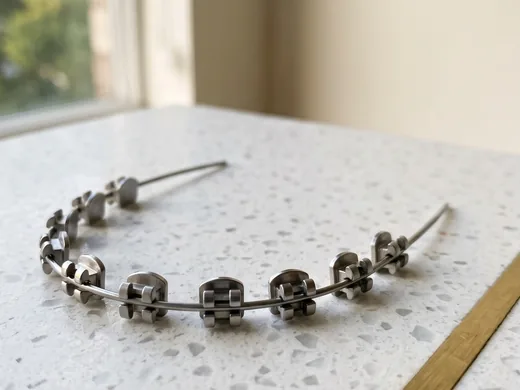
Where those limits apply to your teeth, braces are the alternative the AAO names, and the page on how braces work explains them. Some plans use both appliances in phases, and the practice’s Hybrid treatment is its own version of that route.
Refinements: when the first series of aligners is not the last
The first series of aligners may not be the last, and a review of the research explains why. A 2020 systematic review in Orthodontics and Craniofacial Research (Robertson and colleagues, studies from January 2014 to April 2019) closed its conclusion with this caveat: “Most of the tooth movements may not be predictable enough to be accomplished with only one set of trays with clear aligners despite the recent advances in technology.”
In a retrospective cohort of 324 non-extraction patients using Invisalign aligners, drawn from 11 orthodontists and reported in 2023 by authors at Adelaide Dental School (Meade, Ng and Weir, Journal of Orthodontics), 99.4 percent needed a refinement phase, with a median of two refinement plans, and patients “were prescribed almost double the number of aligners initially predicted to manage their malocclusion.” Those figures belong to that cohort alone, not to anyone else’s patients or to your treatment.
A refinement is a new digital plan and a new set of aligners: Align describes refinements as “additional aligner sets that fine-tune the final result”. How refinements would fit your own plan is a question for the consultation.
Aligners with crowns, bridges, implants, missing teeth or gum disease
Existing dental work and gum health change the plan, and the answers of the American Association of Orthodontists here are general orthodontic facts, not promises about aligners. To the question “I have crowns. Can my teeth be moved?” the AAO’s FAQ answers: “Yes. Teeth with crowns can be moved.” Implants are different: the AAO’s glossary says an orthodontist can create or hold space for patients who may need implants, and that “Dental implants cannot be moved by conventional orthodontic forces.”
For a missing tooth, the AAO’s FAQ says the orthodontist may move neighboring teeth together to close the space or hold a space open for a bridge or an implant, and that “Your orthodontist will work with your family dentist and/or other dental specialists.”
The order of the work is decided together. The AAO’s aligners page says to see your family dentist for a cleaning and check-up first, and that “Any dental work needs to be completed before getting scanned for clear aligners as your aligners will be custom created to the exact shape of your teeth”. The AAO’s FAQ also says many complicated restorations, such as crowns, bridges and implants, can be accomplished more successfully once the remaining teeth are properly aligned and the bite is correct, so your dentist and the orthodontist settle which comes first.
Gum health comes before any of it. The AAO says “the only way to effectively evaluate gum health is in-person, such as through periodontal probing” and warns: “Straightening teeth when the patient has poor periodontal (gum) health can lead to recession (exposure of the tooth roots), root shortening, or tooth loss.” Bring your dental history, including any crowns, implants or gum treatment, to the consultation.
Adults and teens in aligners: growth and checks on wear
For adults, the AAO’s August 2026 article says “The biggest difference in orthodontics for adults vs. children/teens is that adults are no longer growing.” Options beyond aligners, and what the orthodontist weighs in an adult mouth, are set out under treatment for adults.
For teens, Align’s July 2026 teen article says teens should wear their Invisalign clear aligners 20 to 22 hours per day, removing them only to eat, drink anything other than water, and brush and floss, and adds: “Consistent wear is the single most important factor in achieving treatment goals on schedule.” Align also says Invisalign clear aligners for adolescent patients feature built-in compliance indicators on some aligners, “small blue dots that fade with wear”, so parents and providers can confirm the aligners are being worn as prescribed.
Whether a teen’s plan would use those indicators is a question for the consultation; the practice’s page on orthodontics for children and teens covers when to start.
Daily life in aligners: meals, drinks, cleaning and the case
Aligners come out whenever you eat, and the AAO is specific about drinks too. Its FAQ says: “If you eat or drink anything besides tap water, remove your aligners first.” The same answer says to keep them in their case, in a safe place, and to brush your teeth before putting them back in. Align’s 2026 pages make the same exception for water; the AAO specifies tap water.
The reason is what aligners hold against the teeth. The AAO’s 2024 article says “Aligners can trap liquids and food particles against the teeth, increasing the risk of cavities and gum disease.”
Cleaning the aligners is part of the routine. Align’s April 2026 article says to clean them daily: “Use a soft toothbrush and lukewarm water; avoid hot water which can warp the material.” The AAO’s 2024 article adds where they go when they are out: “Do not place aligners in napkins, a pocket, or a purse; keep them away from pets.”
If your plan includes attachments, Align’s attachments article says activities “like using your teeth as tools can cause SmartForce attachments to loosen or fall off”, that regular brushing and flossing can help preserve the bond, and that if one does come off, you contact your orthodontist, who will schedule a time to replace it.
These habits all come back to wear. The AAO’s 2024 article says “the success of clear aligner treatment heavily relies on your compliance” and that inconsistent wear can hinder progress or compromise the results, and Align’s April 2024 guide says “Invisalign treatment requires consistent and responsible wear.”
After the last aligner: attachments off, retainers on, and the next step
Aligner treatment ends with a check as well as a last tray. Align’s attachments article says the orthodontist takes off SmartForce attachments at the end of treatment, after one last check that the teeth have moved into their desired positions, and that “Your orthodontist may want to take a new scan of your teeth after removing your SmartForce attachments” to help with fabricating any retainers you need after treatment.
Retainers keep the teeth where the aligners moved them, and the retainers the practice offers are described on a separate page.
The choice between aligners, braces or both is the orthodontist’s, made for your own teeth and gums rather than from a page. Consultations are always free of charge. You do not need a referral. Where another office has already proposed a plan, we are happy to be a second opinion. Directions to the Domain, Downtown and Westlake offices in Austin, with parking and the sign to look for at each door, are on the Find us page.
Clear aligner questions, answered
Can aligners correct an overbite or an underbite?
The American Association of Orthodontists lists overbite, underbite, open bite and crossbite among the most common conditions treated by aligners, which can be paired with traditional orthodontic elastics. The AAO also says aligners may not work as predictably for severe malocclusions, where braces may offer more precision, so the severity of your bite is part of choosing the appliance.
Can I drink coffee with my aligners in?
No, not by the AAO’s or Align’s instructions. The AAO’s FAQ says to remove aligners before you eat or drink anything besides tap water, and Align’s 2026 pages make water the one drink the aligners can stay in for. The AAO also notes that aligners can trap liquids against the teeth, raising the risk of cavities and gum disease.
What should I do if I lose an aligner?
Call the orthodontist before deciding anything on your own. The AAO’s FAQ says aligners should be worn in a particular sequence and that your orthodontist is the one to call for advice about next steps and whether a lost aligner will extend your treatment time. After hours, the practice puts it this way: If you call our regular phone number after hours, you will hear the phone number of the person on call.
What does an Invisalign provider designation measure?
Align’s doctor locator orders its provider tiers by the number of aligner treatments a provider has prescribed, from fewest to most. Align’s own locator legend says the tiers are “not intended to reflect the quality or skill level of the provider”.
Sources
- Align Technology (invisalign.com), How Does the Invisalign Treatment Work?
- Align Technology (invisalign.com), Invisalign Digital Treatment For Aligners
- Align Technology (invisalign.com), Invisalign Attachments
- Align Technology (invisalign.com), Invisalign Week 1 vs Week 2: Your First Two Weeks Journey
- Align Technology (invisalign.com), Invisalign clear aligners for teens
- Align Technology (invisalign.com), Common myths about Invisalign aligners
- Align Technology (invisalign.com), What are Invisalign aligners and how they are different from braces
- Align Technology (invisalign.com), Can Clear Aligners Treat Severe Bite Problems and Crowding?
- American Association of Orthodontists, Clear Aligners
- American Association of Orthodontists, Clear Aligner Therapy
- American Association of Orthodontists, What to Expect During Orthodontic Treatment
- American Association of Orthodontists, Orthodontists Respond to Frequently Asked Questions from Adults Considering Treatment
- American Association of Orthodontists, How Old Is Too Old For Braces?
- American Association of Orthodontists, Teeth Spacing: Causes, Concerns, and Treatment Options
- American Association of Orthodontists, Orthodontic FAQs: Your Questions Answered
- American Association of Orthodontists, Orthodontic Glossary
- Rossini and colleagues, The Angle Orthodontist, 2015, Efficacy of clear aligners in controlling orthodontic tooth movement: a systematic review
- Ke and colleagues, BMC Oral Health, 2019, A comparison of treatment effectiveness between clear aligner and fixed appliance therapies
- Papageorgiou and colleagues, European Journal of Orthodontics, 2020, Treatment outcome with orthodontic aligners and fixed appliances: a systematic review with meta-analyses
- Robertson and colleagues, Orthodontics and Craniofacial Research, 2020, Effectiveness of clear aligner therapy for orthodontic treatment: A systematic review
- Koletsi and colleagues, Journal of Orthodontics, 2021, Predictability of rotational tooth movement with orthodontic aligners comparing software-based and achieved data: A systematic review and meta-analysis of observational studies
- Meade, Ng and Weir, Journal of Orthodontics, 2023, Digital treatment planning and clear aligner therapy: A retrospective cohort study
- Alhafi and colleagues, European Journal of Orthodontics, 2025, Quality and stability of orthodontic treatment outcomes with clear aligners versus fixed appliances: a systematic review and meta-analysis
Ask whether clear aligners suit your teeth at a consultation
Use the request form on this page to ask for a consultation, and bring the questions this page raised about attachments, wear and your own teeth.
Domain, Downtown and Westlake: Monday to Thursday, 8:15 a.m. to 5:00 p.m.Updated .