

What are aligner attachments, and does everyone get them?
Align Technology says of its SmartForce attachments, in an article dated September 2023, “Attachments are custom-made to fit your teeth and positioned to guide the movement of your teeth. They work like handles, giving your clear aligners something to gently push on”.
Aligner attachments are tooth-colored bumps on the teeth that give clear aligners something to push on, and not every patient needs them, Align Technology says. The American Association of Orthodontists (AAO) says they help move the teeth and that the need for them depends on the treatment plan. Align says the number varies from every tooth to just a couple, and that only the orthodontist can say for sure.
Handles on the teeth: Align’s description and the AAO’s glossary
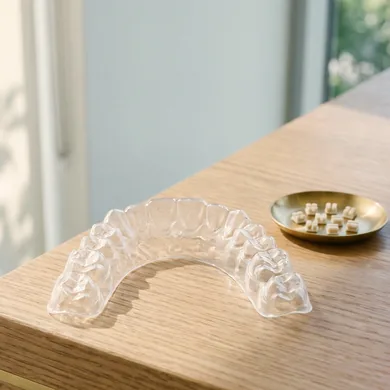
An aligner attachment is a tooth-colored bump that helps a clear aligner move a tooth, going by the American Association of Orthodontists (AAO) and Align Technology. The AAO’s glossary says of these bumps, “They help move the teeth while a patient wears aligners. They are removed once treatment is complete.”
Align calls the attachments used in Invisalign® treatment SmartForce attachments, and its September 2023 article compares them to handles. The AAO’s January 2019 article comparing braces and clear aligners says “Tooth colored attachments are frequently placed on the teeth to help guide the teeth into place.” Frequently is the AAO’s word there, and it does not say whether a given plan needs them.
The mechanics are explained under how clear aligners move teeth, and the word itself has a glossary entry for aligner attachment.
Does every patient get attachments? The AAO’s and Align’s answers
Not every patient needs attachments, by Align Technology’s account, and the AAO makes it a question of the treatment plan.
- The AAO’s FAQ says: “It depends on your treatment plan. Talk to your orthodontist about whether you will need these attachments to move your teeth.”
- Align’s September 2026 article says: “Not every patient needs attachments, and the number and placement will vary depending on what movements your treatment plan requires.”
- Align’s September 2023 article says, on who decides: “Will I need SmartForce attachments? Only your orthodontist can say for sure.”
- The same Align article says, on how many: “You may need attachments on every tooth or just a couple needing additional support.”
None of those lines gives a rate or says how many patients have them. How many your own plan would need, and on which teeth, is the question to put to the orthodontist.
How attachments go on, and what can loosen one
Attachments are bonded to the teeth with the help of a tray, in both the AAO’s and Align’s descriptions. The AAO’s FAQ says “the tooth surface will be etched with a mild solution” so that attachments bond to the enamel, that the tooth is then rinsed, and that “a special adhesive will go in the aligner trays and they will be placed on the teeth and cured with a special light.”
Align’s September 2023 article describes a template aligner loaded with the attachment material, a composite resin, placed over the teeth and pressed so the attachments adhere, then hardened with a special light.
Once on, attachments can still come loose: Align’s September 2023 article says “Activities like using your teeth as tools can cause SmartForce attachments to loosen or fall off.”
What reviews say about attachments and predictability
Systematic reviews say attachments mostly help tooth movement with aligners, and the same reviews report limits. A 2022 systematic review of five clinical trials (Nucera and colleagues, Materials), searched to March 2020 with all five at medium risk of bias, says “attachments mostly increase the effectiveness of orthodontic treatment with clear aligners,” naming rotation among other movements. Nucera and colleagues also say “some articles showed contradictory or not statistically significant results” and that evidence on intrusion and extrusion is lacking.
A 2023 systematic review of 26 articles (Jedliński and colleagues, International Journal of Environmental Research and Public Health) concludes “The use of attachments significantly improves the expression of orthodontic movement and aligner retention,” while its background says “it is often still a challenge to clinically achieve the planned movement.”
On rotation alone, a 2021 systematic review and meta-analysis (Koletsi and colleagues, Journal of Orthodontics), searched to August 2020 with evidence it graded low to moderate, reports that software predictions of rotation were not accurate, in its words “irrespective of the use of attachments or interproximal enamel reduction (IPR).”
Those reviews describe groups of patients and are no promise that attachments will make a given movement predictable. Whether a movement suits aligners with attachments, or a plan that uses braces as well, is the orthodontist’s judgment, and the practice’s Hybrid treatment is one such plan.
Taking attachments off at the end of treatment
Attachments come off when treatment ends: Align’s September 2023 article says “Your orthodontist will take off your SmartForce attachments at the end of your treatment.”
A 2026 systematic review (Nassar and colleagues, Clinical Practice), which assessed three laboratory studies and no clinical trials, says removal “appears to be associated with measurable enamel loss and residual composite, largely influenced by the instruments and visualization aids used,” and adds that “given the scarcity of evidence and absence of clinical trials, these findings cannot be directly extrapolated to routine clinical practice.”
That finding comes from the laboratory and is no claim about your teeth; how attachments are taken off is a fair question for the orthodontist. Other questions about living with aligners are gathered in one place.
Seeing an attachment, and losing one
Can people see aligner attachments?
Some may be easier to see than others, by Align Technology’s account. Align’s September 2023 article says “Some attachments may be more visible than others, depending on their location,” and that those on the front teeth may be easier to see than those on the molars. If visibility concerns you, raise it with the orthodontist when your plan is discussed.
What should you do if an attachment comes off?
Call the orthodontist’s office. Align’s September 2023 article says to contact your orthodontist if one falls off, and “They will schedule a time to replace it.” If you call our regular phone number after hours, you will hear the phone number of the person on call. The answer on orthodontic emergencies sorts other appliance problems.
Sources
- Align Technology (invisalign.com), Invisalign Attachments
- Align Technology (invisalign.com), Common myths about Invisalign aligners
- American Association of Orthodontists, Glossary of Orthodontic Terms
- American Association of Orthodontists, Orthodontic FAQs: Your Questions Answered (read November 6, 2026)
- American Association of Orthodontists, Aligners vs. Braces: A Comparison
- Nucera and colleagues, Materials, 2022, Effects of Composite Attachments on Orthodontic Clear Aligners Therapy: A Systematic Review
- Jedliński and colleagues, International Journal of Environmental Research and Public Health, 2023, Attachments for the Orthodontic Aligner Treatment: A Comprehensive Systematic Review
- Koletsi and colleagues, Journal of Orthodontics, 2021, Predictability of rotational tooth movement with orthodontic aligners comparing software-based and achieved data: A systematic review and meta-analysis of observational studies
- Nassar and colleagues, Clinical Practice, 2026, Enamel Integrity and Residual Composite Following Clear Aligner Attachment Removal: A Systematic Review
Ask whether your plan would need attachments at a consultation
Consultations are always free of charge. You do not need a referral. Request a consultation below for the Domain, Downtown or Westlake office.
Domain, Downtown and Westlake: Monday to Thursday, 8:15 a.m. to 5:00 p.m.Updated .