

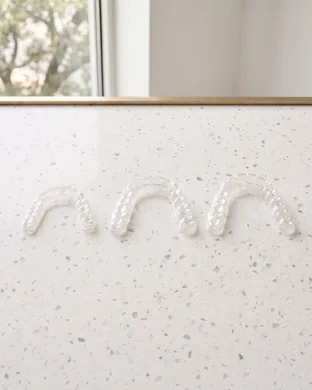
Do clear aligners work for teenagers?
For a teenager, the question behind this one is who keeps the aligners in, so this page begins with wear and then sets out what the sources do and do not show.
Not without wear: the American Association of Orthodontists (AAO) says aligners “can only move teeth when they are in your mouth” and that “the success of clear aligner treatment heavily relies on your compliance.” Align Technology’s July 2026 teen article tells teens to wear its aligners 20 to 22 hours per day. A teen’s own hours, and whether aligners suit that teen, come from the orthodontist.
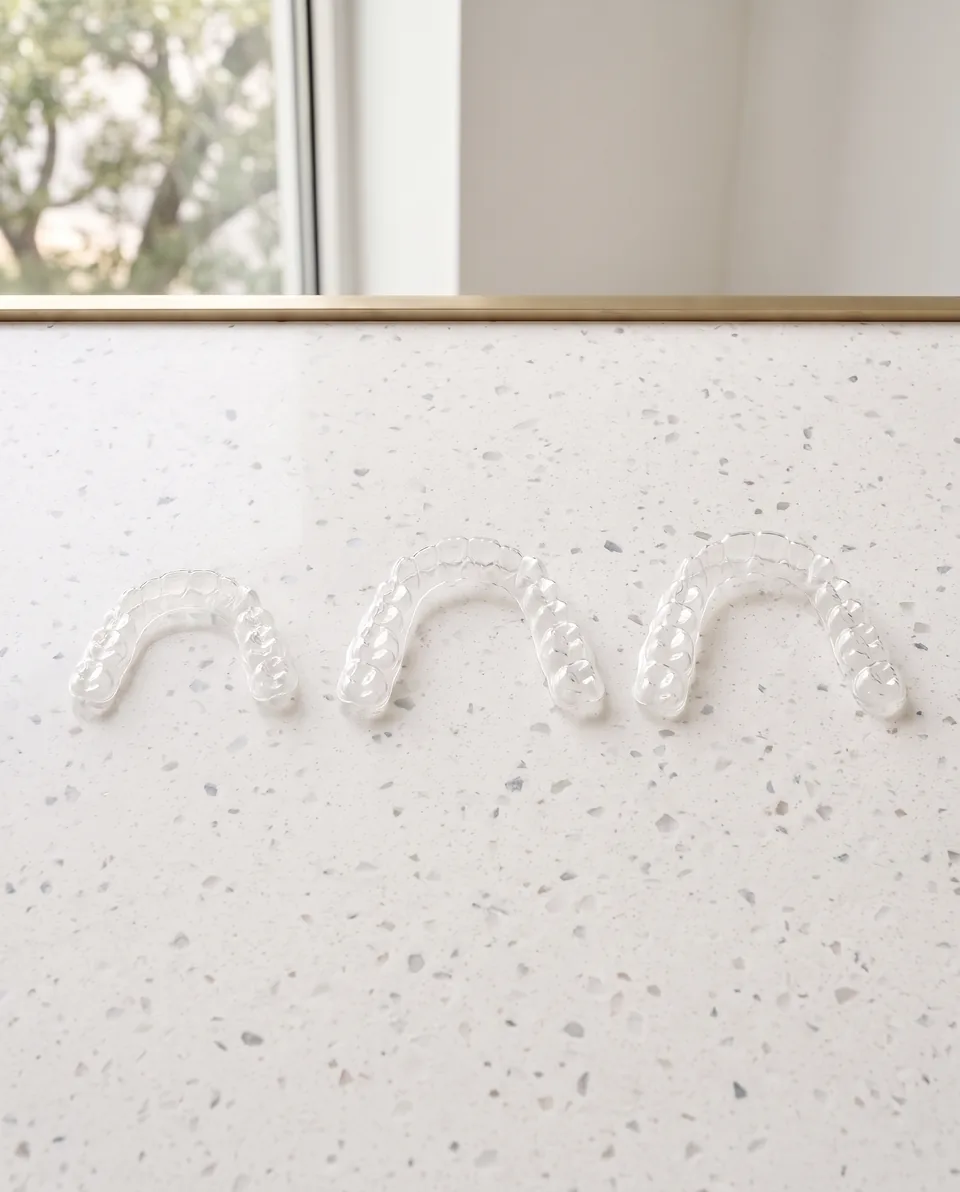
Compliance: what clear aligner treatment relies on at any age
For a teen the question turns on wear, and the American Association of Orthodontists’ (AAO) 2024 article on clear aligner therapy puts it in a sentence about aligners at any age: “the success of clear aligner treatment heavily relies on your compliance.” The same article gives the reason: “Since they’re removable, inconsistent aligner wear can hinder your progress, extending the length of treatment or compromising the results.”
The AAO’s glossary says patients are responsible for insertion and removal. For a teenager, that means the person putting the trays back in after lunch is the teenager. These AAO lines are general: they do not single out teens, and none of them promises a result.
How many hours: Align’s figure for teens, the AAO’s figure and your orthodontist’s
Align Technology, which makes Invisalign® clear aligners, gives teens a figure in its July 2026 teen article: “Teens should wear their Invisalign clear aligners 20 to 22 hours per day, removing them only to eat, drink anything other than water, and brush and floss. Consistent wear is the single most important factor in achieving treatment goals on schedule.” Its October 2026 article on its app says of teens that “as wear time decreases, treatment can slow down”.
The American Association of Orthodontists’ (AAO) FAQ says at least 22 hours a day, Align says 20 to 22, and your teen’s own hours come from the orthodontist. What a series of trays does is explained on the page about Invisalign clear aligners.
The blue dots on some aligners for adolescents, and a 2011 laboratory test
Align describes a wear indicator on some aligners for teens, and a 2011 laboratory test sets a limit beside it. Align’s September 2026 page on aligner myths says “Invisalign clear aligners for adolescent patients also feature built-in compliance indicators on some aligners (small blue dots that fade with wear), giving parents and providers a simple, visible way to confirm the aligners are being worn as prescribed.”
A 2011 laboratory study by Schott and Göz in The Angle Orthodontist tested the blue indicators in Align’s teen aligners of that time, outside the mouth, and reports: “Color fading was observed as a function of time, pH, and temperature while compliance indicators were stored in drinking water or sour soft drinks and in conjunction with the use of cleaning tablets and a dishwasher.” The study concludes: “Compliance indicators are not immune to simple intentional or unintentional manipulations.”
Neither one is a verdict on the indicators in a teen’s aligners today, and whether a teen’s aligners would carry them is a question for the consultation.
Fit, tracking and what a trial in adults found about wear time
An orthodontist can evaluate fit and tracking, the American Association of Orthodontists’ (AAO) FAQ says, and if treatment is not tracking as expected, “aligner wear may be one factor they consider.”
A 2026 randomized trial of 43 adults, 40 of them analyzed, by Sabbagh and colleagues in the American Journal of Orthodontics and Dentofacial Orthopedics used aligners fitted with sensors, reports that wear time declined significantly at later visits, and concludes: “Awareness of being monitored improved patient compliance and can be used as an effective strategy to enhance WT during aligner therapy in adults.” WT is wear time.
That trial was in adults, so it says nothing direct about teens; for a parent, the practical step is to ask how the orthodontist would review a teen’s wear. How an orthodontist reads a teen’s wear, and when a teen might start, are on the page about orthodontics for children and teens.
Choosing a plan: braces, Hybrid treatment and Dr. Kunik’s approach to teens
The choice of appliance follows the diagnosis. The American Association of Orthodontists’ (AAO) October 2024 release for adults says “If there is any reason why clear aligners are not the optimal choice or a viable choice to correct orthodontic problems for a patient who prefers aligners, the orthodontist may present treatment plans involving braces.” That concerns choosing a plan, and it does not address whether anyone wears their aligners.
Hybrid is the practice’s name for a plan with a braces phase and an aligner phase, set out on the page on Hybrid treatment. The practice describes it this way. We may adjust your braces, provide new aligner sets, or transition between methods as your treatment progresses.
Dr. Kunik’s approach to teen orthodontic treatment is compassionate and considerate, informed by his own experiences as a parent. Dr. Kunik is here to listen to your smile goals, listen to your timeline, and listen to what is most important to you. If your teen plays a sport, the page on sports with braces or aligners covers game days, and the index of orthodontic questions covers more.
Permanent teeth and wear time: more on teens and aligners
Can a teen have clear aligners before all the permanent teeth are in?
Align draws its line at permanent teeth, and the answer for your teen comes from the orthodontist. Align’s October 2026 page says “Regular Invisalign treatment is for teens and adults with a full set of permanent teeth.” What that means for a teen whose teeth are still coming in is the orthodontist’s call at an exam.
Do patients wear removable appliances as long as they think they do?
Not according to a 2017 systematic review and meta-analysis by Al-Moghrabi and colleagues in the American Journal of Orthodontics and Dentofacial Orthopedics, which concluded: “Compliance with removable orthodontic appliances and adjuncts is suboptimal, and patients routinely overestimate duration of wear.” Its abstract does not name aligners or teens, so it is no statement about your teen.
Sources
- American Association of Orthodontists, Clear Aligner Therapy: How Transparent Aligners Work
- American Association of Orthodontists, Glossary of Orthodontic Terms
- American Association of Orthodontists, Orthodontic FAQs: Your Questions Answered (read November 6, 2026)
- American Association of Orthodontists, Orthodontists Respond to Frequently Asked Questions from Adults Considering Treatment
- Align Technology (invisalign.com), Invisalign clear aligners for teens
- Align Technology (invisalign.com), How the Invisalign app keeps treatment on track
- Align Technology (invisalign.com), Common myths about Invisalign aligners
- Align Technology (invisalign.com), Invisalign First clear aligners for kids
- Schott TC, Göz G, The Angle Orthodontist, 2011 (PubMed record), Color fading of the blue compliance indicator encapsulated in removable clear Invisalign Teen® aligners
- Sabbagh H and others, American Journal of Orthodontics and Dentofacial Orthopedics, 2026 (PubMed record), Objective assessment of wear time during orthodontic aligner therapy using microsensors: A randomized controlled trial
- Al-Moghrabi D, Salazar FC, Pandis N, Fleming PS, American Journal of Orthodontics and Dentofacial Orthopedics, 2017 (PubMed record), Compliance with removable orthodontic appliances and adjuncts: A systematic review and meta-analysis
Go over a teen’s aligner wear at a consultation
Consultations are always free of charge. You do not need a referral. Choose My teen in the consultation request on this page.
Domain, Downtown and Westlake: Monday to Thursday, 8:15 a.m. to 5:00 p.m.Updated .