

Braces or Invisalign® aligners for a teenager: what each asks of a school week
Dr. Kunik’s approach to teen orthodontic treatment is compassionate and considerate, informed by his own experiences as a parent.
No single choice fits every teenager: the American Association of Orthodontists (AAO) lists metal or ceramic braces and clear aligners among the options for teens, and says clear aligner success relies heavily on compliance, so the choice turns on what the teeth need and on whether the trays will be worn. Treatment in the teen years runs through school, sport and band, and the AAO says most teens can expect regular check-ins.
The teen years in the AAO’s words, and the ages it gives
The American Association of Orthodontists (AAO) states its reason for the teen years in a family guide dated December 16, 2025: “Teen smiles are in a prime window for treatment because permanent teeth are in place and growth can still be guided.” The AAO’s guide names crowding, spacing and bite problems among the common concerns of the teen years.
The AAO’s FAQ, in an answer published on aaoinfo.org in 2022, gives a range rather than one age: “many patients begin treatment between the ages of 9 and 16, depending on their physiological development and treatment needs,” and another of its answers says there is not one “right” chronological age for orthodontic treatment and that timing is determined by the type of problem and the child’s stage of dental development.
The British Orthodontic Society, in advice written for the United Kingdom, says: “Most children begin treatment around the age of 12 or 13, once all their permanent teeth have erupted.” For one teenager, the timing is set at an examination of the teeth and the bite.
A school week in braces: lunch, the toothbrush and the cleaning tools
Lunch changes with braces. The AAO’s 2023 guide to living with braces counts taco chips, popcorn, caramels and nuts among the foods to avoid for the duration of treatment because they may damage braces, and it says to avoid regular and diet soft drinks while the braces are on.
Brushing moves into the school day too. The AAO’s general guidance in its 2023 guide, with the orthodontist’s specific instructions governing, is to brush for two minutes after every meal or snack and before bed, and the AAO’s FAQ says “Floss threaders, orthodontic flossers, interproximal brushes, and water flossers can all make it easier to clean around brackets and wires.” The braces page has the whole routine, and swollen gums with braces are covered in a separate answer.
The British Orthodontic Society, in advice to schools written for the United Kingdom, says “Some teenagers can feel self-conscious about wearing an appliance at least in the early stages,” a worry a teenager can bring to the consultation.
A school week in clear aligners: out for lunch, back in after brushing
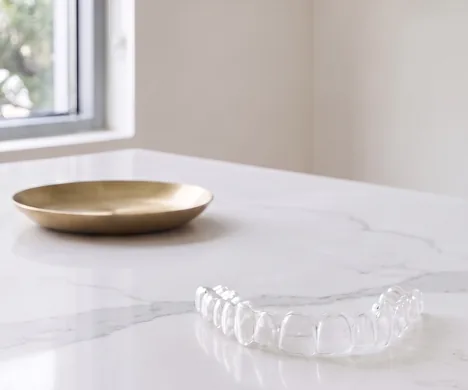
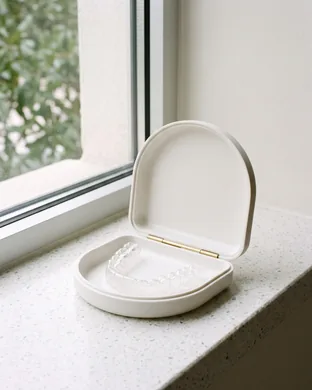
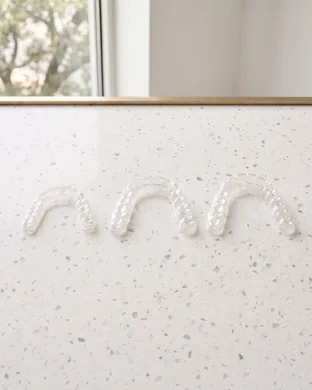
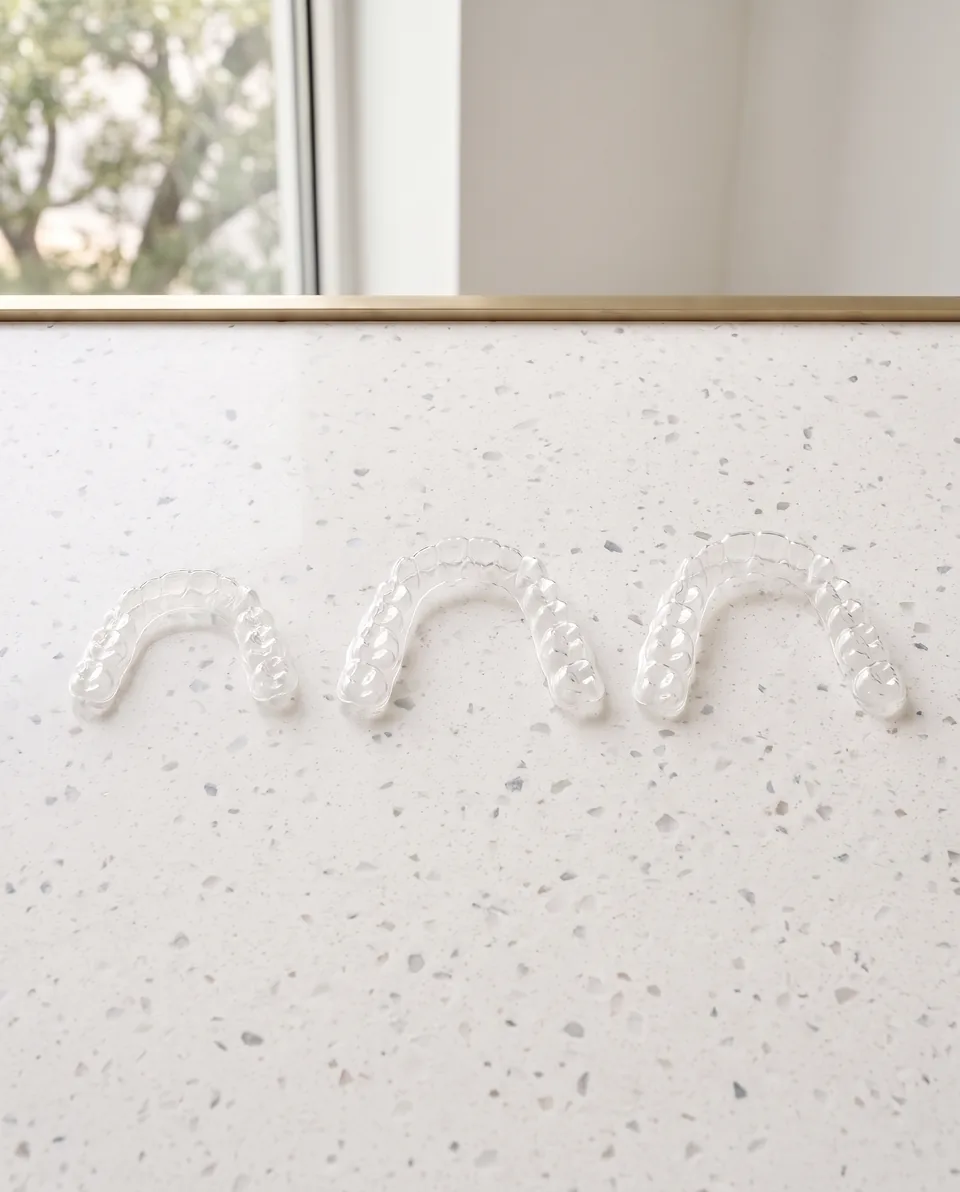
Clear aligners turn lunch into a routine of their own: the trays come out to eat and go back in afterward. The AAO’s FAQ says to remove aligners before eating or drinking anything besides tap water, put them in their case, and brush before putting them back in, and its 2024 article on aligners adds: “Do not place aligners in napkins, a pocket, or a purse; keep them away from pets.”
Wearing the trays is the teenager’s job. The AAO’s glossary says of aligners, “Patients are responsible for insertion and removal,” and its 2024 article says “the success of clear aligner treatment heavily relies on your compliance.” Align Technology, which makes Invisalign aligners, says in its July 2026 teen guide that “Consistent wear is the single most important factor in achieving treatment goals on schedule.”
Whether clear aligners work for teenagers, with the wear indicators Align describes and a 2011 laboratory test of the indicators of that time, is the subject of the answer on clear aligners for teens. Your teen’s wear instructions come from Dr. Kunik.
Game days, band and orchestra with braces or aligners
Sport and music both go on during treatment, with a word to the orthodontist first. For sport, the AAO’s family guide says “If your teen plays sports, mouthguards are highly recommended,” and which mouthguard, and whether aligners come out for a game, are the orthodontist’s call, as the answer on sports with braces or aligners explains.
For band and orchestra, the AAO’s FAQ answers in one line: “Yes, that is if you could play a musical instrument before you started orthodontic treatment.” The British Orthodontic Society, in advice for musicians written for the United Kingdom, says to “talk to your orthodontist about the instrument you play, the brace you will need and the possible difficulties you may have with your musical performance” before treatment starts, and to try to time a new brace away from important music exams, auditions or performances.
The British Orthodontic Society’s advice for musicians, written for the United Kingdom, speaks of a fixed brace and of removable braces; a removable one, it says, can usually come out while playing, and it asks players to “Tell your orthodontist how many hours you practice each day,” because “Leaving your brace out for long periods of time might influence the success of your treatment.” The British Orthodontic Society’s United Kingdom advice on taking a brace out is about removable braces, so whether a teen’s clear aligners come out for band practice is Dr. Kunik’s instruction.
The teenager’s part and the parent’s part between check-ins
Treatment in the teen years runs on appointments, and the AAO’s family guide says “Most teens can expect regular check-ins to monitor their orthodontic treatment.” How often one teenager comes in is set by the office.
Between check-ins, an appliance can break at school or on the field. For a loose bracket, the answer on orthodontic emergencies gives the AAO’s home steps; a lost or damaged aligner gets a plain instruction from the AAO: “If you should lose or damage an aligner, contact your orthodontist immediately for advice.”
On the parent’s part, in a 2026 questionnaire study in the American Journal of Orthodontics and Dentofacial Orthopedics (Yin and colleagues), parents of 124 children and adolescents aged 6 to 18 in clear aligner treatment rated compliance, and closer, lower-conflict parent-child relationships were associated with better compliance, a correlation the authors call “statistically significant, but relatively weak.” Ratings by parents do not show that a parent’s involvement changes how the aligners are worn.
Choosing braces or clear aligners for one teenager
The AAO’s family guide lists today’s options for teens as traditional metal or ceramic braces, low-profile brackets and clear aligners, ranks none of them, and says what goes into the choice: “Activity-heavy schedules, band or athletics, and even social confidence all factor into choosing the right approach, along with a solid hygiene plan to keep gums and enamel healthy around appliances.”
On wear, the AAO’s article on ceramic braces says patients “who would rather not manage removable trays, or who may have difficulty wearing aligners consistently, may prefer fixed braces,” while patients who want to take the appliance out for meals may prefer clear aligners. The teeth matter as well: a 2026 scoping review in Frontiers in Dental Medicine (Borzabadi-Farahani) says evidence suggests clear aligner treatment is less predictable for certain tooth movements, among them rotations and closing extraction spaces, limits the Invisalign treatment page sets out.
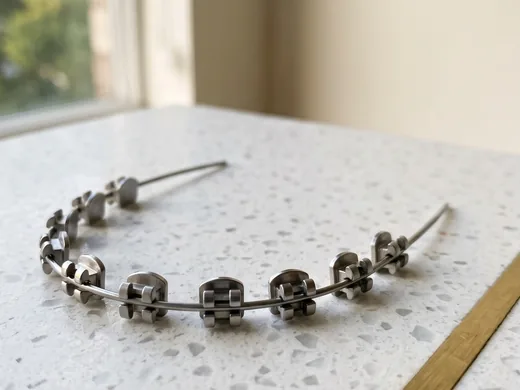
Among the practice’s treatments are braces, with metal or ceramic brackets, Invisalign treatment and Hybrid. Ceramic braces, the AAO says, are sometimes called clear braces and use clear or tooth-colored brackets designed to blend in with the teeth; Hybrid treatment, the practice’s own route, uses braces and clear aligners within one plan. Which suits one teenager is decided at the examination.
Elastics, growth and the evidence on prominent front teeth
Elastics, where the orthodontist prescribes them, are the teenager’s to wear. The AAO’s page on orthodontic elastics says “Patients are responsible for placing and removing their elastics, and wearing them as your orthodontist prescribes. It’s important not to wear more elastics than prescribed.” In a 2014 study in the American Journal of Orthodontics and Dentofacial Orthopedics (Veeroo and colleagues), 14 adolescents interviewed while wearing elastics full time named cues to remember, eating, social situations, sports and lost or broken elastics among the factors in their wear; the study, which also ran a pilot with 12 participants, reported that compliance was highly variable among patients.
For prominent upper front teeth, which Cochrane’s 2018 review also calls Class II malocclusion, the review concluded that “Low-quality evidence suggests that, compared to no treatment, late treatment in adolescence with functional appliances, is effective for reducing the prominence of upper front teeth.” The American Academy of Pediatric Dentistry’s 2024 guideline, in its passage on Class II bites, adds a caution: response to growth-modification treatment, such as a functional appliance, varies substantially, and no reliable predictors of a favorable growth response have been found.
On timing for prominent upper front teeth, Cochrane’s 2018 review compared early treatment in two phases with one phase in adolescence, and concluded on evidence of low to moderate quality that early treatment is more effective at reducing new injuries to the upper front teeth and that “There appear to be no other advantages of providing early treatment when compared to late treatment.” The early half of that question is on the page about orthodontics for children, and what one teen’s bite needs is decided at the examination.
After treatment: wisdom teeth, and a retainer that goes to college
Wisdom teeth arrive late: the American Dental Association’s 2012 permanent tooth chart gives the third molars, the wisdom teeth, an eruption age of 17 to 21 years. The ADA tells teens that wisdom teeth “don’t always cause problems, but sometimes there’s not enough space in your mouth for them,” and that “After looking at your dental X-rays, your dentist might advise that your wisdom teeth come out.”
Retention outlasts the teen years. The AAO says “Typically, a retainer is necessary for a lifetime, though the frequency of wear may decrease over time,” and that the amount and frequency of wear can vary, so patients should follow their orthodontist’s instructions rather than a general schedule; the guidance on how long is set out on the retainers page.
A retainer, then, goes to college with the teenager. The AAO’s family guide counts alignment shifts after earlier treatment or lost retainers among the common concerns of the teen years, and a lost or broken retainer has a page of its own, on replacement retainers. To start, ask for a consultation at the Domain, Downtown or Westlake office.
What parents and teenagers ask before treatment starts
How does the orthodontist know whether a teen is wearing the aligners?
The American Association of Orthodontists’ FAQ says “Your orthodontist can evaluate how your aligners fit and whether your teeth are moving as planned.” If treatment is not tracking as expected, the same answer says, aligner wear may be one factor the orthodontist considers.
Can a teenager play a wind or brass instrument with braces?
Usually, according to the British Orthodontic Society’s advice for musicians, written for the United Kingdom: “Most wind instrument musicians will get used to wearing a fixed brace within a few months.” The British Orthodontic Society’s United Kingdom advice adds that brass players, such as trumpet or trombone players, may have problems playing high notes, especially soon after the brace is first fitted, and that products of plastic or wax can protect the lips while playing, with the orthodontist advising which. Name the instrument to Dr. Kunik before treatment starts.
Do wisdom teeth undo the result after braces?
The reviews disagree. A 2026 systematic review in Clinical Oral Investigations (Amberg and colleagues), of patients who wore no retention devices after treatment, found no consistent indication that wisdom teeth meaningfully influence crowding of the front teeth afterward, on evidence it rates very low certainty; a 2024 meta-analysis of observational studies in The Angle Orthodontist (Palikaraki and colleagues) concluded that lower wisdom teeth may contribute to crowding and narrowing of the lower arch. The braces page sets the reviews on wisdom teeth side by side. Removal is decided with the dentist, and holding the teeth in place afterward is the retainer’s job in the American Association of Orthodontists’ description.
Does a teenager miss school for orthodontic appointments?
Some time away is possible. The American Association of Orthodontists’ FAQ says “There may be some time away from work or school during your orthodontic treatment,” and that with braces “the longest appointments will be to place and remove your braces, and will likely be scheduled during the work day.” Appointment times are arranged with the office.
Sources
- American Association of Orthodontists, Your Guide to Orthodontic Health (December 16, 2025)
- American Association of Orthodontists, Orthodontic FAQs: Your Questions Answered (FAQ listing, page 23, as read November 6, 2026)
- American Association of Orthodontists, FAQ record 5156: What if my child is older than 7, is it too late for a check-up?
- British Orthodontic Society (United Kingdom), FAQs
- American Association of Orthodontists, Living with Braces: Food, Oral Hygiene, & Care Tips
- American Association of Orthodontists, Orthodontic FAQs: Your Questions Answered (FAQ listing, page 4, as read November 6, 2026)
- British Orthodontic Society (United Kingdom), FAQs for Schools
- American Association of Orthodontists, Orthodontic FAQs: Your Questions Answered (FAQ listing, page 27, as read November 6, 2026)
- American Association of Orthodontists, Clear Aligner Therapy: How Transparent Aligners Work
- American Association of Orthodontists, Glossary of Orthodontic Terms
- Align Technology (invisalign.com), Invisalign clear aligners for teens: everything parents and teens need to know (July 2026)
- American Association of Orthodontists, Orthodontic FAQs: Your Questions Answered (FAQ listing, page 32, as read November 15, 2026)
- British Orthodontic Society (United Kingdom), Advice for Musicians
- American Association of Orthodontists, What is an Orthodontic Emergency?
- Yin Z and others, American Journal of Orthodontics and Dentofacial Orthopedics, 2026 (PubMed record), The association between parent-child relationship and orthodontic compliance with clear aligners among children and adolescents
- American Association of Orthodontists, What Are Ceramic Braces?
- Borzabadi-Farahani A, Frontiers in Dental Medicine, 2026 (PubMed Central), Clear aligner therapy: a scoping review of treatment prediction, clinical effectiveness, and limitations
- American Association of Orthodontists, Orthodontic Elastics: Are They For You?
- Veeroo HJ, Cunningham SJ, Newton JT, Travess HC, American Journal of Orthodontics and Dentofacial Orthopedics, 2014 (PubMed record), Motivation and compliance with intraoral elastics
- Cochrane Database of Systematic Reviews, 2018, Orthodontic treatment for prominent upper front teeth (Class II malocclusion) in children and adolescents, abstract
- American Academy of Pediatric Dentistry, Management of the Developing Dentition and Occlusion in Pediatric Dentistry
- American Dental Association, MouthHealthy, Permanent Tooth Development (eruption chart)
- American Dental Association, MouthHealthy, Dental concerns for teens
- American Association of Orthodontists, Orthodontic Retainers: Types, Care, & Life After Braces
- American Association of Orthodontists, My Retainer Feels Tight or Doesn’t Fit. Should I Force It?
- American Association of Orthodontists, Orthodontic FAQs: Your Questions Answered (FAQ listing, page 3, as read November 6, 2026)
- Amberg S and others, Clinical Oral Investigations, 2026 (PubMed record), Wisdom teeth removal and anterior alignment stability after orthodontic treatment-a systematic review
- Palikaraki G, Mitsea A, Sifakakis I, The Angle Orthodontist, 2024 (PubMed record), Effect of mandibular third molars on crowding of mandibular teeth in patients with or without previous orthodontic treatment: a systematic review and meta-analysis
- American Association of Orthodontists, Orthodontic FAQs: Your Questions Answered (FAQ listing, page 14, as read November 15, 2026)
Weigh braces and aligners for your teenager at a consultation
Consultations are always free of charge. You do not need a referral. For a teenager, pick My teen in the consultation request below.
Monday to Thursday, 8:15 a.m. to 5:00 p.m. Closed 1:00 to 2:15 p.m. for lunch. Downtown is by appointment only, on Thursdays.Updated .