

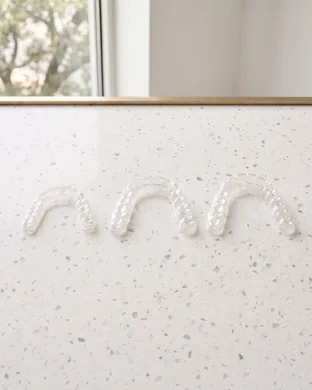
Can you have clear aligners with a missing tooth or an implant?
An implant and a missing tooth raise different questions; this page says what the American Association of Orthodontists publishes on each and who decides the rest.
Not to move the implant itself: the American Association of Orthodontists (AAO) says “Dental implants cannot be moved by conventional orthodontic forces.” Depending on what is missing, its FAQ says, an orthodontist may close the space or hold it open for a bridge or implant, working with your family dentist and/or other dental specialists. These statements cover orthodontic treatment in general, not aligners in particular, so your orthodontist answers for your own teeth.

Dental implants and conventional orthodontic forces
Dental implants have a rule of their own in the American Association of Orthodontists’ (AAO) glossary: “Dental implants cannot be moved by conventional orthodontic forces.” That line speaks of conventional orthodontic forces in general and does not name aligners.
The same glossary says what an implant is: “An artificial replacement for a missing tooth/teeth. The process involves placing a metal post in the jawbone. A crown is placed on the implant so that the patient is able to bite, chew and speak.” The glossary also says what an orthodontist can do for someone who may need one: “An orthodontist can create space or hold space open in the mouths of patients who may need implants to achieve good dental function.”
If you have an implant, say so at the start, because the AAO’s line applies to that tooth and the orthodontist needs to know which tooth it is.
Closing a missing tooth’s space, or holding it open for a bridge or implant
A missing tooth’s space may be closed or held open, and the American Association of Orthodontists’ (AAO) FAQ puts both as something the orthodontist may choose: “Depending on what is missing, your orthodontist may choose to move neighboring teeth together to close the space where the tooth is missing or hold open a space for a bridge or implant.”
Like the implant line, that answer covers orthodontic treatment generally. It does not say how aligners close or hold a space, so how that would work with aligners is a question for the orthodontist who has seen your teeth.
Closing a gap in general, whether or not a tooth is missing, has its own answer under what causes gaps between teeth. The practice offers Invisalign® clear aligners, and how clear aligners work is a page of its own.
Neighboring teeth and the open space a lost tooth leaves
Neighboring teeth are the reason the American Association of Orthodontists (AAO) gives for caring about an open space. Its June 2026 article on teeth spacing says “Missing teeth can lead to gaps as surrounding teeth shift into the open space over time”, and its September 2025 article on how a smile changes with age says “Implants, bridges, or partials fill the space left by a lost tooth so neighboring teeth do not tip or rotate into the gap”.
Those are general explanations, not a recommendation of any replacement for your tooth, and how far your own teeth have shifted is for an exam to show. Whether the tooth is replaced at all, and how, belongs to your dentist, working with the orthodontist.
Replacing the tooth first, or moving the other teeth first
The order of replacing a tooth and moving the others is a joint decision for your dentist and orthodontist, and the American Association of Orthodontists (AAO) speaks to both sides. Asked why a dentist might recommend orthodontic treatment before replacing missing teeth, its FAQ says the dentist is probably recommending it so that you can reach optimal dental health, and that many complicated restorations, bridges and implants among them, can be accomplished well when the remaining teeth are properly aligned and the bite is correct.
For clear aligners, its aligners page says “Any dental work needs to be completed before getting scanned for clear aligners as your aligners will be custom created to the exact shape of your teeth”. Neither line is a schedule for you. If your dentist has proposed a bridge or an implant, show that plan to the orthodontist so the two can settle the order.
Your family dentist, other specialists and the consultation
A missing-tooth plan is shared work in the American Association of Orthodontists’ (AAO) account: “Your orthodontist will work with your family dentist and/or other dental specialists.” The AAO’s August 2026 article on adults goes further: “For some adults to reach optimal dental health, the dentist and orthodontist may need to call in other dental specialists such as oral surgeons, periodontists, and endodontists.”
Those lines do not say who would treat you, so ask your dentist who would place any replacement and how the space would look while treatment runs, and ask the orthodontist how the work would be shared.
Kunik Orthodontics serves a majority adult clientele, prioritizing realistic expectations, clear communication, and customized treatment plans. At a consultation, bring what your dentist has told you about the tooth and any replacement being planned. The page on treatment as an adult deals with restorations in general, and the orthodontic questions and answers list what else people ask.
Bridges, implants and how long a space has been open
How does a bridge differ from an implant?
The American Association of Orthodontists’ glossary describes an implant as a metal post placed in the jawbone with a crown on it, and a bridge as “A replacement for a missing natural tooth/teeth that fills the opening between adjacent teeth”, adding “Most often, the existing adjacent teeth receive crowns and a prosthetic (false) tooth is attached to the crowns.” Which one, if either, suits you is a question for your dentist.
Does it matter how long ago the tooth was lost?
Time can matter in the American Association of Orthodontists’ general account: its June 2026 article says surrounding teeth can shift into an open space over time, and its December 2025 family guide says older restorations may complicate alignment if teeth have migrated. Neither line gives a timetable, so how far your own teeth have moved is for an exam to show.
Sources
- American Association of Orthodontists, Glossary of Orthodontic Terms
- American Association of Orthodontists, Orthodontic FAQs: Your Questions Answered (read November 6, 2026)
- American Association of Orthodontists, Clear Aligners
- American Association of Orthodontists, Teeth Spacing: Causes, Concerns, and Treatment Options
- American Association of Orthodontists, Does Your Smile Change As You Age?
- American Association of Orthodontists, How Old Is Too Old For Braces?
- American Association of Orthodontists, Your Guide to Orthodontic Health
Take your missing tooth or implant questions to a consultation
Consultations are always free of charge. You do not need a referral. Ask for one with the request on this page, and bring your dentist’s notes.
Domain, Downtown and Westlake: Monday to Thursday, 8:15 a.m. to 5:00 p.m.Updated .