

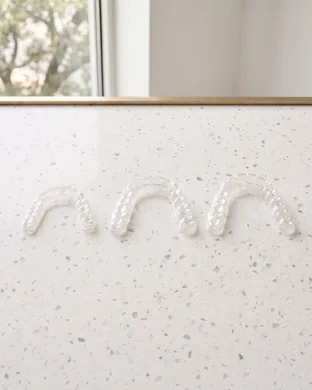
What is an open bite, and how is it treated?
Thumb sucking in early childhood is one of the habits the American Association of Orthodontists says can lead to an open bite, and a habit is something a parent can notice. Closing the bite is a separate question, and the evidence on braces, Invisalign® treatment and other appliances for it is mixed.
Teeth that do not make contact are an open bite in the American Association of Orthodontists’ glossary; in an anterior open bite, the front teeth do not touch when the back teeth are closed. The AAO names habits such as thumb sucking among its causes and says adults can treat it with braces or clear aligners; for children, Cochrane rates the treatment evidence as weak.
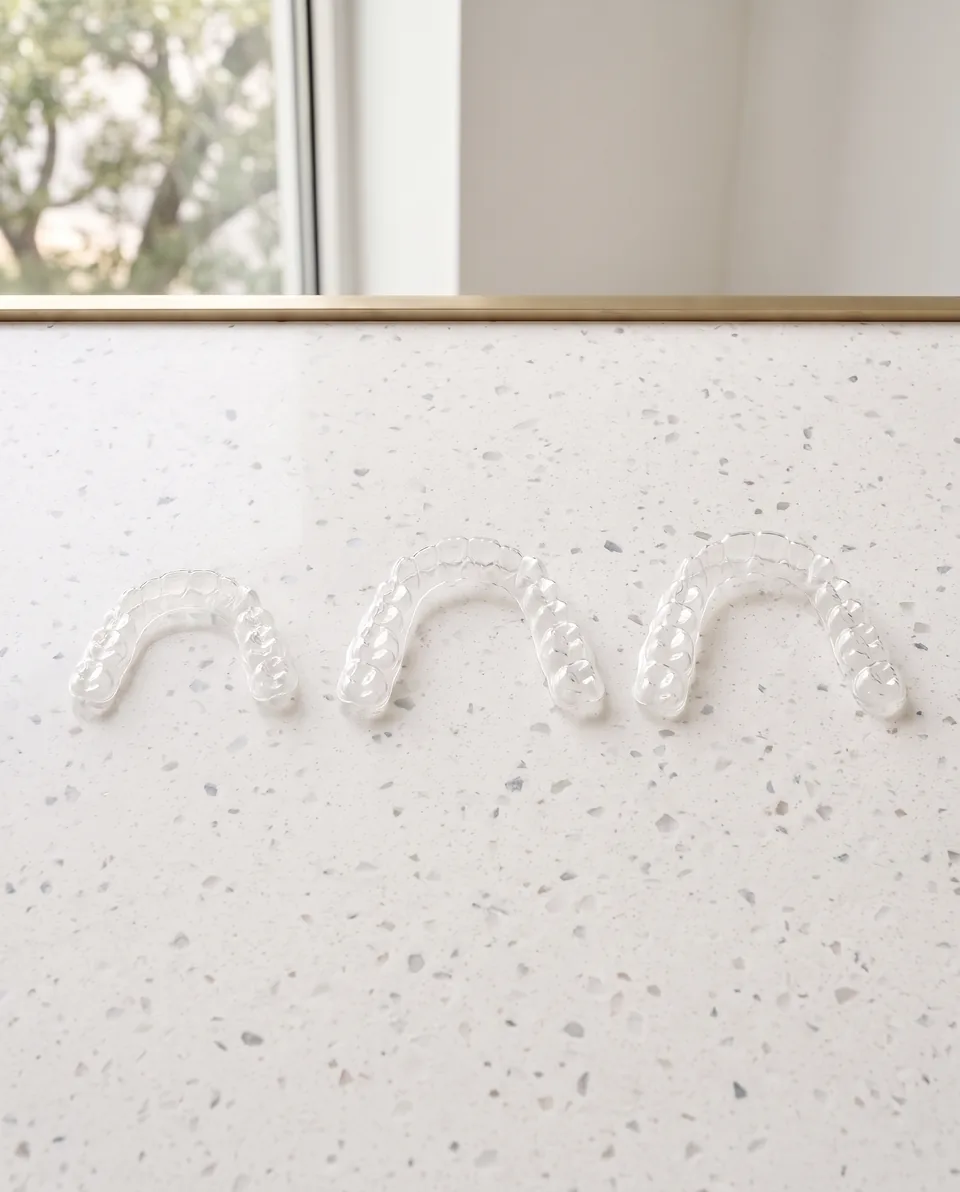
Thumb sucking and tongue habits in young children
The AAO ties a front open bite to habits in early childhood: it “can result from habits such as thumb sucking, improper tongue positioning, or mouth breathing during early dental development.”
How much a habit matters depends on how much it happens. The American Academy of Pediatric Dentistry (AAPD) says “Habits of sufficient frequency, duration, and intensity may be associated with dentoalveolar or skeletal deformations such as increased overjet, reduced overbite, open bite, posterior crossbite, or increased facial height.”
Stopping the habit may not undo the bite. The AAPD adds: “Some evidence indicates that changes resulting from sucking habits persist past the cessation of the habit.” That is why an open bite in a child who has already stopped is still worth an examination.
For the habit itself, the AAO’s FAQ names two kinds of help, with tongue position when swallowing and with stopping a thumb or finger sucking habit, and says habit appliances are sometimes used for both. Habit appliances are on the practice’s list for early treatment, which in its own words is expanders, Invisalign First, braces, and habit appliances; the children and teens page covers when a sucking habit starts to matter.
Front and back open bites, as the AAO glossary and Cochrane define them
The AAO glossary defines an open bite as “A malocclusion in which teeth do not make contact with each other.” The glossary then splits it in two: “With an anterior open bite, the front teeth do not touch when the back teeth are closed together. With a posterior open bite, the back teeth do not touch when the front teeth are closed together.”
Cochrane’s 2014 review of front open bites in children describes the same problem in terms of overlap: “Anterior open bite occurs when there is a lack of vertical overlap of the upper and lower incisors.” Most of the habit and treatment evidence on this page concerns that front, anterior kind, and a shorter version of the definition sits in the glossary’s open bite entry.
Growth patterns and the jaw side of an open bite
An open bite can come from more than habits. Cochrane’s review calls its causes multifactorial, listing “oral habits, unfavourable growth patterns, enlarged lymphatic tissue with mouth breathing.”
The AAPD’s guideline describes the changes habits bring as dentoalveolar or skeletal. An unfavorable growth pattern is the jaw side of that fork, and a habit that has moved the teeth is the tooth side.
Which side of that fork a bite sits on decides what treatment can do, and telling the two apart is the examination’s job.
Closing an open bite with braces or aligners: three reviews disagree
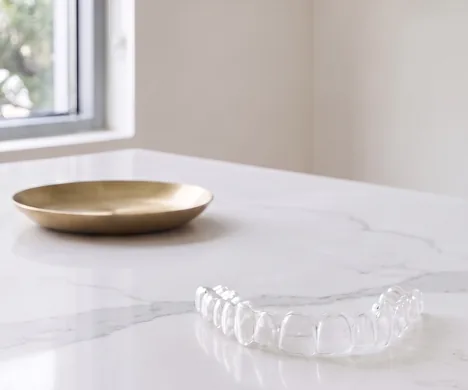
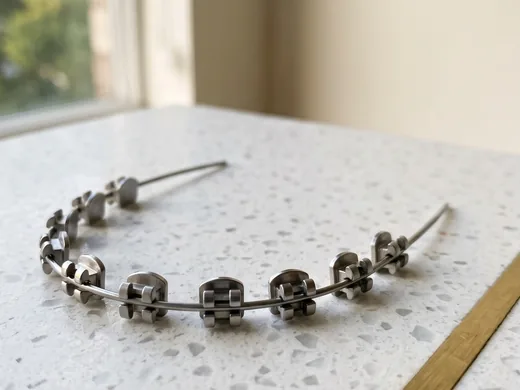
For adults, the AAO’s adult orthodontics page is direct about an open bite: “Adults can treat it with braces or clear aligners.” The practice offers metal and ceramic braces and Invisalign treatment, and the page on braces details how brackets and wires move teeth.
On aligners, three reviews pull in different directions over one movement, extrusion of the front teeth. A 2019 systematic review of tooth movement with Invisalign aligners (Galan-Lopez and colleagues, Korean Journal of Orthodontics) reports that an open bite “is primarily corrected by extrusion of incisors without changes in the mandibular plane.” A 2015 systematic review (Rossini and colleagues, The Angle Orthodontist) found that aligner treatment “is effective in controlling anterior intrusion but not anterior extrusion,” and asked that its results be read with caution. A 2026 scoping review (Borzabadi-Farahani, Frontiers in Dental Medicine) calls clear aligner therapy “most reliable for anterior open bite correction under 3 mm,” while warning that its estimates come from heterogeneous research focused on one aligner brand and are not universal benchmarks.
For children, Cochrane’s 2014 review is more cautious still: on treatments for front open bites it says “interventions are not supported by strong scientific evidence,” found only weak evidence for two appliance combinations, and concluded: “Recommendations for clinical practice cannot be made based only on the results of these trials.”
Read together, the AAO names braces and clear aligners for adults, the reviews divide on how predictably aligners close an open bite, and the evidence in children is weak, so the choice is made one bite at a time at the consultation; how clear aligner trays work is a question for the practice’s aligner page.
Jaw-level open bites and the oral surgeon
If the jaws themselves are behind an open bite, the AAO’s division of roles applies: “An orthodontist moves teeth and guides jaw growth using braces or aligners. An oral surgeon corrects skeletal jaw discrepancies through surgery.”
Because an adult’s jaws have finished growing, the AAO says, surgery is the one way their size, shape or position can be changed, and the referral to the oral surgeon, when the orthodontist judges surgery would help, comes before orthodontic treatment starts. For the wider adult picture, see treatment for adults.
In a growing child, the orthodontist’s side of that division includes guiding jaw growth, which is one more reason an open bite in a child is worth an early look.
Habit, teeth or jaw: sorting out an open bite at the consultation
The consultation turns the open bite evidence into a plan for one person: whether a habit is still active, whether the bite is at the front or the back, whether the teeth or the jaws are behind it, and whether braces, Invisalign treatment or Hybrid treatment fits, or a surgeon’s opinion is needed first.
At Kunik Orthodontics, we provide age-appropriate treatment options from early intervention for children to discreet solutions for adults. Overbites, underbites and crossbites each get an answer in the same collection of questions.
Open bite questions about breathing and chewing
Does mouth breathing cause an open bite?
Sometimes. The AAO lists mouth breathing during early dental development among the habits from which a front open bite can result, and Cochrane’s review of children names enlarged lymphatic tissue with mouth breathing among the causes. Whether it has played a part in a particular child’s bite is a question for the examination.
Does an open bite affect more than how the teeth look?
Yes. The AAO says an open bite affects chewing, speech and appearance. That is why an open bite is worth an examination even when appearance is not the worry, and why the AAO’s adult orthodontics page names braces and clear aligners as ways adults can treat one.
Sources
- American Association of Orthodontists, 7 Types Of Bite Problems and Their Orthodontic Solutions
- American Association of Orthodontists, Glossary of Orthodontic Terms
- Lentini-Oliveira and others, Cochrane Database of Systematic Reviews, 2014 (PubMed record), Orthodontic and orthopaedic treatment for anterior open bite in children
- American Academy of Pediatric Dentistry, Management of the Developing Dentition and Occlusion in Pediatric Dentistry
- American Association of Orthodontists, Orthodontic FAQs: Your Questions Answered (FAQ listing, page 21)
- American Association of Orthodontists, Adult Orthodontics: Smile with Confidence at Any Age
- Galan-Lopez and colleagues, Korean Journal of Orthodontics, 2019 (PubMed Central), A systematic review of the accuracy and efficiency of dental movements with Invisalign
- Rossini and colleagues, The Angle Orthodontist, 2015 (PubMed record), Efficacy of clear aligners in controlling orthodontic tooth movement: a systematic review
- Borzabadi-Farahani, Frontiers in Dental Medicine, 2026 (PubMed Central), Clear aligner therapy: a scoping review of treatment prediction, clinical effectiveness, and limitations
- American Association of Orthodontists, Dentist vs. Orthodontist vs. Oral Surgeon: What’s the Difference?
- American Association of Orthodontists, Orthodontic Surgery: Enhancing Your Smile’s Foundation
Have an open bite, and any habit behind it, looked at in a consultation
Consultations are always free of charge. You do not need a referral. Begin with a consultation request, or call the Domain, Downtown or Westlake office.
Domain, Downtown and Westlake: Monday to Thursday, 8:15 a.m. to 5:00 p.m.Updated .