

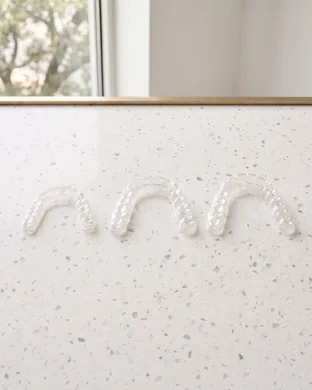
Can you wear clear aligners if you have crowns or veneers?
Here is what the American Association of Orthodontists says about crowns and veneers, what a search found, and who decides the rest.
Yes for moving crowned teeth in general: the American Association of Orthodontists (AAO) says teeth with crowns can be moved, a statement about orthodontic treatment rather than aligners in particular. That line names crowns, not veneers, and a search of AAO and Align Technology pages, read November 6, 2026, found no statement on bonding an aligner attachment to either. Your orthodontist and dentist decide for your teeth.
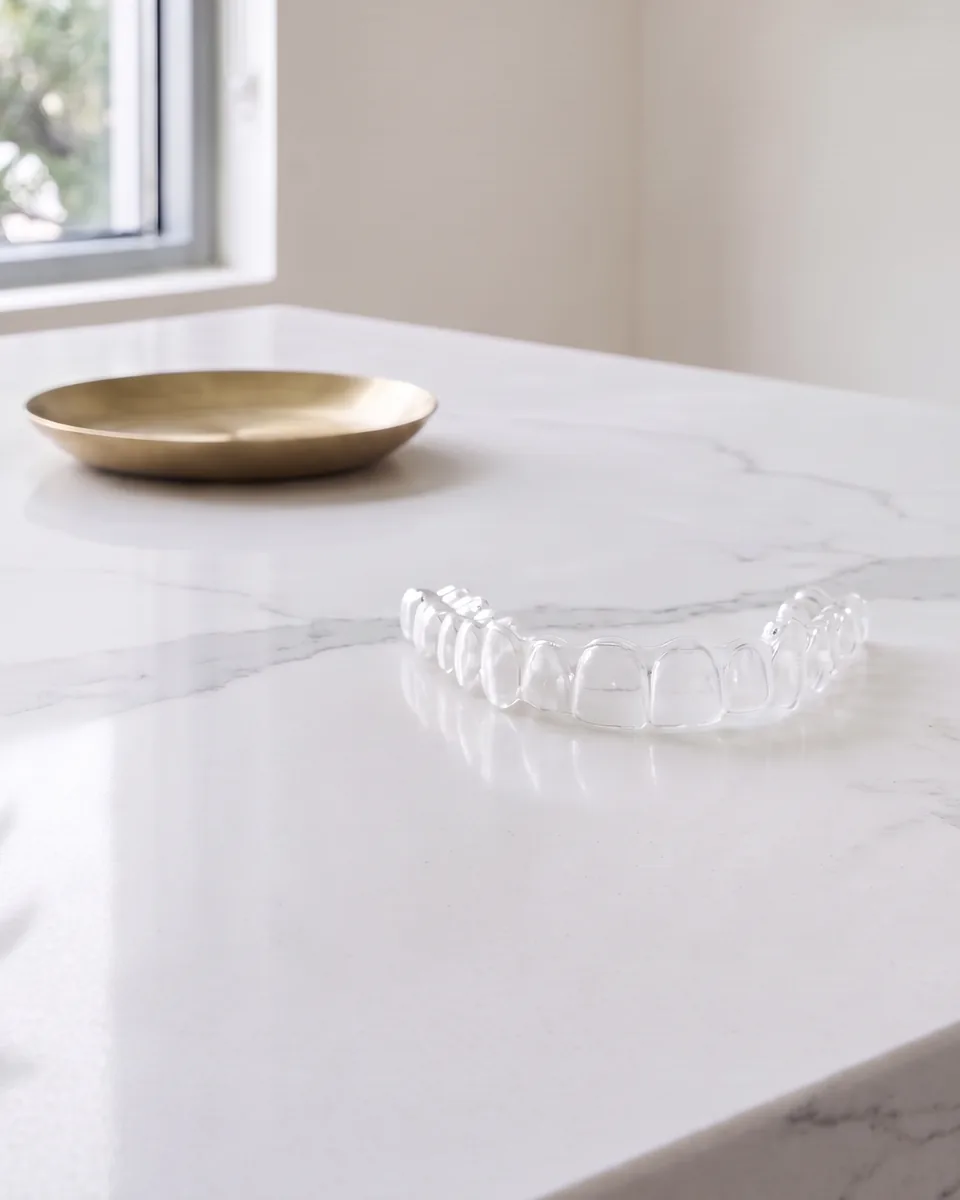
A tooth with a crown can be moved, in the AAO’s FAQ
One line of the American Association of Orthodontists’ (AAO) FAQ answers the crown question, speaking of orthodontic treatment generally, not aligners in particular: “I have crowns. Can my teeth be moved? Yes. Teeth with crowns can be moved.”
The AAO’s glossary says “Crowns placed by dentists can last for many years, but they are not permanent”, and calls a veneer “A thin, tooth-colored shell that is glued to the fronts of teeth to improve their appearance.”
The FAQ’s answer names crowns and not veneers, so it is no answer about a veneer, and whether aligners suit your own teeth is decided at an exam. Implants are covered under aligners with a missing tooth or an implant.
Dental work before the aligner scan, or after the teeth are aligned
The order of dental work and aligners is for your dentist and orthodontist to decide together, because the American Association of Orthodontists (AAO) makes a point on each side. Its aligners page says “Any dental work needs to be completed before getting scanned for clear aligners as your aligners will be custom created to the exact shape of your teeth”. A new crown or veneer changes a tooth’s shape. Its FAQ also says crowns, bridges and implants are among the many complicated restorations that can be accomplished well with the remaining teeth properly aligned and the bite correct.
The AAO’s September 2025 article on adult treatment adds that “Any active decay, gum disease, or unstable restorations should be addressed first”, and that your “orthodontist may coordinate with your general dentist, periodontist, or prosthodontist”. How aligners move teeth is on the clear aligners page.
Attachments on a crown or veneer: what a search found
A search of published pages, read November 6, 2026, found no American Association of Orthodontists (AAO) or Align Technology statement on bonding an attachment to a crown, a veneer or porcelain, or on wearing aligners over veneers. The pages read were the AAO’s FAQ, glossary, aligners page and adult treatment guide, and the resource and product pages of Align Technology, the maker of Invisalign® clear aligners. An attachment, in the AAO’s glossary, is a tooth-colored bump placed on a tooth during clear aligner treatment.
What the AAO does describe is bonding to enamel: its FAQ says “so that attachments bond to the tooth enamel, the tooth surface will be etched with a mild solution.” That names enamel and no restoration, and it is not a statement that attachments cannot go on a crown or a veneer. Whether one would go on yours, and how that surface would be treated, is for the orthodontist and your dentist to settle.
What laboratory reviews report about attachments and crown materials
A 2026 systematic review of laboratory studies, not patients, by Kaur and colleagues in Frontiers in Dental Medicine, on attachments and what it calls aesthetic crown materials, reports: “The findings showed a positive increase in bond strength and surface roughness following surface treatments.” Its authors say laboratory studies cannot fully reproduce the mouth, and that the review found no studies of attachment bond strength on feldspathic porcelain.
The same authors, in that review of laboratory studies and not of patients, say: “Generally, bonding of attachments on crowns is discouraged unless it is necessary for treatment.” That sentence is the authors’, not a society’s, about crowns and not veneers, and it does not say attachments are never placed on a crown; your own crown is a consultation question.
A 2014 systematic review by Grewal Bach and colleagues in The Angle Orthodontist, on bonding brackets, not attachments, to porcelain and searching to July 2013, found no clinical (in vivo) studies that met its criteria, only 45 laboratory (in vitro) studies. Neither review speaks for all research, and neither the 2026 review’s full text nor the 2014 review’s abstract names veneers.
The 2026 authors, again in that laboratory review, also write that a crown restoration’s material and surface can directly influence attachment stability, and that this underscores the value of “close interdisciplinary communication between orthodontists and restorative dentists”. For your own crown, or a veneer neither review names, the question runs through your orthodontist and dentist.
Your crowns and veneers at a consultation
A consultation is for your own crowns and veneers; published lines are general. Kunik Orthodontics serves a majority adult clientele, prioritizing realistic expectations, clear communication, and customized treatment plans.
The American Association of Orthodontists (AAO) describes part of what an orthodontist checks in person: its October 2024 release for adults says “X-rays are the only way to see underneath the gums”, and that gum health is evaluated effectively in person. Another answer walks through a first orthodontic consultation.
Write down which teeth have crowns or veneers and any dental work planned, along with the cleaning and check-up the AAO advises before aligners, and ask whether an attachment would go on either.
Adult restorations in full are under orthodontic treatment for adults, and more answers sit with the questions people ask an orthodontist.
Veneers and older dental work: follow-up questions
Can a veneer straighten my teeth instead of aligners?
No. The American Association of Orthodontists’ glossary says “Veneers cannot correct malocclusions (misaligned teeth and/or jaws).” The glossary adds that “veneers can be easier to place and last longer after an individual has had orthodontic treatment and teeth are properly positioned”, a general observation, not a promise about your veneers.
Can older crowns or bridges complicate straightening teeth?
Older restorations can, according to the American Association of Orthodontists, whose December 2025 family guide says “older restorations (crowns, bridges, implants) may complicate alignment if teeth have migrated.” That line is about adults, not aligners specifically, and whether it describes your teeth is for the orthodontist to judge at an exam.
Sources
- American Association of Orthodontists, Orthodontic FAQs: Your Questions Answered (read November 6, 2026)
- American Association of Orthodontists, Glossary of Orthodontic Terms
- American Association of Orthodontists, Clear Aligners
- American Association of Orthodontists, Orthodontic Treatment for Adults: The Rise of Adult Braces
- American Association of Orthodontists, Your Guide to Orthodontic Health
- American Association of Orthodontists, Orthodontists Respond to Frequently Asked Questions from Adults Considering Treatment
- Align Technology (invisalign.com), Invisalign Attachments
- Kaur A, Soans CR, Ravi MS, Shilpa M, Frontiers in Dental Medicine, 2026 (full text), Evaluation of bonding of clear aligner attachments on aesthetic crown materials: a systematic review of in vitro studies
- Grewal Bach GK, Torrealba Y, Lagravère MO, The Angle Orthodontist, 2014 (PubMed record), Orthodontic bonding to porcelain: a systematic review
Crowns, veneers and aligners: raise them at a consultation
Consultations are always free of charge. Mention your crowns and veneers when you request a consultation from this page.
Domain, Downtown and Westlake: Monday to Thursday, 8:15 a.m. to 5:00 p.m.Updated .